


818 Fake US Banking Sites: Pre-Holiday Phishing Campaign Exposed
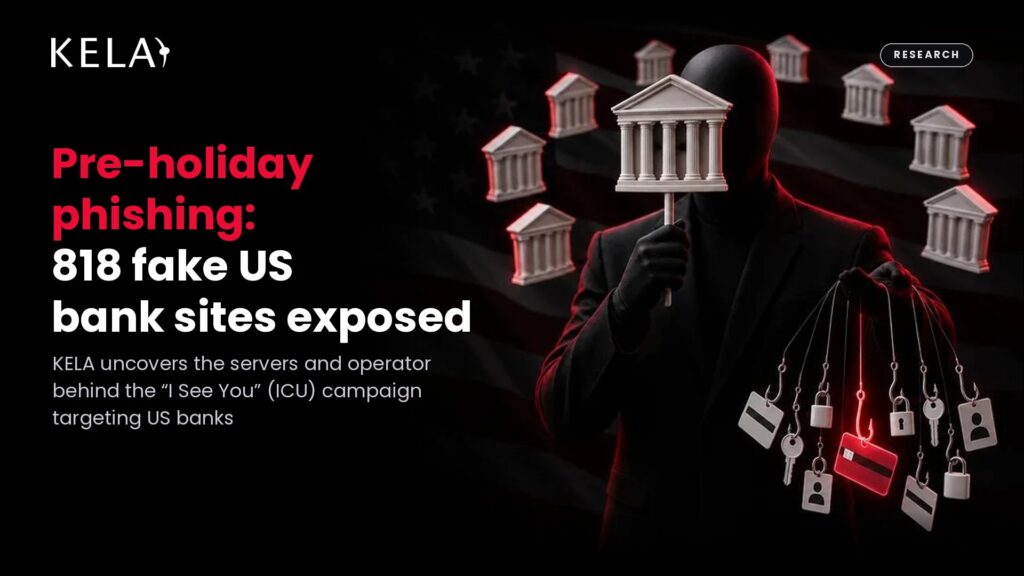
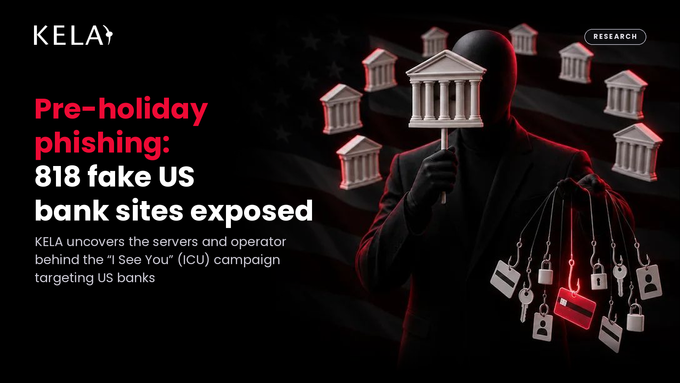
KELA uncovers the servers and operator behind the “I See You” (ICU) campaign targeting US banks


Updated November 25, 2026
Just as Americans start checking balances, approving card payments and reacting to fraud alerts for the holiday season, a phishing operation is waiting for them.
KELA has uncovered 818 fake banking sites built to steal the logins of customers at more than 170 US banks and credit unions. The campaign is still growing: new domains were registered as recently as mid-November.
KELA names this campaign ‘I See You’ after the .icu domain most of its sites run on. Behind the sites sits a commercial phishing kit, a network of hidden servers, and an operator whose own infected computers gave him away.
‘I See You’ is the second large-scale phishing operation impersonating US financial institutions that KELA has uncovered in a month. In early November 2026, KELA published its research on the ‘Suspended’ infrastructure, a network of 248 live look-alike domains impersonating 189 US financial institutions that shows returning visitors a fake ‘account suspended’ page.
ICU is a separate operation, with a different registrar, top-level domain, hosting and phishing kit. Taken together, the two campaigns show sustained phishing pressure on the customers of US regional banks and credit unions, including business-banking users. ICU also goes further: this time, KELA followed the infrastructure past the fake sites, through the servers hiding behind Cloudflare, to an individual operator.
Useful Links
KELA is making this research available now to enable defenders and investigators.
- Law Enforcement Report Please use this link to request the full unredacted report, we are supporting law enforcement agencies on this and other phishing campaigns, so reach out to our team for the latest information.
- Public (Redacted) Report Please use this link for the ICU report. To support law enforcement investigations, this version is redacted for non-Law Enforcement organizations to place actionable information in the hands of defenders.
- Free Lookup Tool Worried your bank or credit union is being impersonated? Check the lookup tool now.
ICU by the Numbers
To provide a sense of scale, this is what KELA has discovered so far as a breakdown, correct as of November 25, 2026:
Metric | Count |
|---|---|
Fake banking domains | 818, most of them on .icu |
Serving a live bank login page | 67 |
Showing the kit’s “Page Expired” notice | 171 |
Live or recently expired | 238 |
On servers that are currently unreachable | 424 |
Dead | 156 |
US banks and credit unions impersonated | More than 170 |
Hidden origin servers uncovered | 21 |
Most of the targets are mid-sized regional and community banks and credit unions, which often have fewer resources to spot and take down look-alike domains.
One Kit, Hundreds of Fake Banks
Every ICU site runs the same phishing kit with a different bank’s branding. A victim usually arrives from a text message or email. They first see a fake security check. On one site, it was an “Unusual Wire Activity Detected” alert asking the visitor to confirm or deny a wire transfer. In a busy shopping season, that kind of alert feels routine, and it creates urgency.
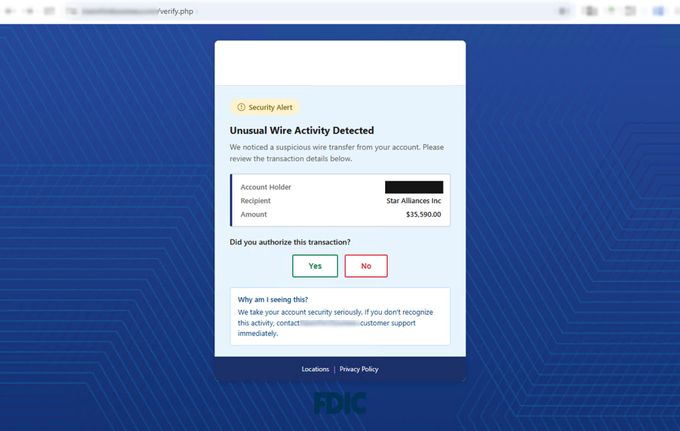
The “Unusual Wire Activity Detected” page
Next comes a copy of the bank’s login page. It asks for the password twice, so the operator can catch typos and confirm the password works. The stolen logins go to admin panels on throwaway hosts, and to Telegram bots.
When a site’s license runs out, the kit shows a “Page Expired” notice telling the reader to contact the developer to renew it, “only if you know him”. That line is addressed to the criminals renting the kit. ICU is phishing sold as a service: one party builds and licenses the kit, and others run the campaigns.
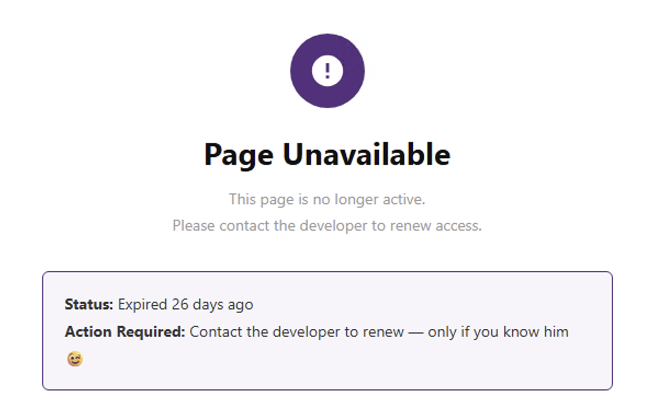
The kit’s “Page Expired” screen
Hiding Behind Cloudflare, Until They Weren’t
Every ICU domain sits behind Cloudflare, which hides the real servers. A takedown can remove one domain while the server behind it keeps running and serves the next one.
The cover has gaps. In the first hours after a domain is registered, before Cloudflare is switched on, it often points straight at its real server. KELA tracked those moments through historical DNS and NetFlow, and uncovered 21 origin servers behind the campaign.
Unmasking an Operator
One of those servers led to a person. Using passive data from its data lake, KELA traced the server to an individual operator, active since at least 2020, who has targeted Wells Fargo, Chase, Huntington, Discover, Cash App and PayPal customers for years.
The trail ran through his own computers. Information stealers infected his machines in 2021, 2023 and again in January 2026, the first two through cracked spam software he downloaded himself. The logs from those machines show him running the campaign hands-on: buying virtual phone numbers, setting up hosting and certificates, installing the kit, collecting stolen credentials and sending the lures. They also show the tools of a modern phishing operation, including Evilginx to capture login sessions and a local AI model for writing lures.
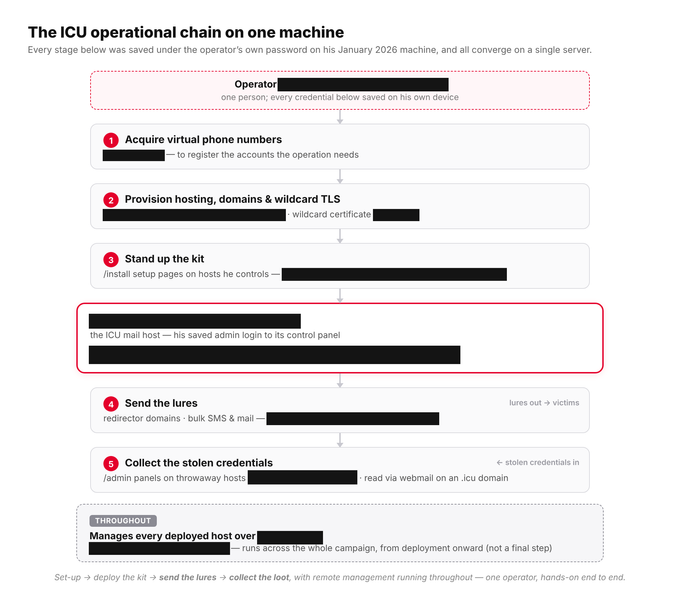
The ICU operational chain, with operator identifiers redacted
He doesn’t hide his tradecraft, either: he even runs a YouTube channel. KELA has identified the operator and shared his identity and the supporting evidence with law enforcement. We are not publishing those details, and share them only with verified law enforcement agencies on request, so that the investigation can continue.
Is Your Bank on the List?
KELA’s free Bank Phishing Check lets banks and credit unions see whether ICU, or the earlier ‘Suspended’ campaign, has targeted them. It covers live pages and recently expired ones, because an expired page means a working phishing site was there until recently.
Recommendations
For Banks and Credit Unions
- Check the lookup tool, and add any domains listed for your institution to your blocklists and customer fraud alerts.
- Monitor for look-alike domains on low-cost top-level domains such as .icu, including domains that appear parked or expired.
- Send takedown requests to the domain registrar as well as to Cloudflare. Removing the Cloudflare front leaves the server running.
- Before the holiday rush, remind customers that you will never ask them to confirm a wire transfer through a link.
For Security Teams
- Block the origin servers and IoCs listed in the redacted report.
- Watch for admin panels and webmail logins on newly registered .icu domains in your traffic.
For Bank Customers
- Open your bank’s app or type its web address yourself. Don’t follow links in texts or emails.
- Treat any urgent message about an unusual transaction as suspect, and call the number on the back of your card.
- Check the address bar before you sign in. A bank login page on a .icu domain is fake.
Get the Report
The ICU report covers the infrastructure, the phishing kit, how the operator runs the campaign and the indicators of compromise defenders need.
Law Enforcement Report
Please use this link to request the full unredacted report.
Redacted Report
Please use this link and ask for the ICU report.