

How Threat Sharing Strengthens Your Business Network
Threat intelligence sharing accelerates threat detection, reduces alert fatigue, and creates sector-wide resilience by enabling organizations to defend collaboratively rather than in isolation.




Published September 3, 2026
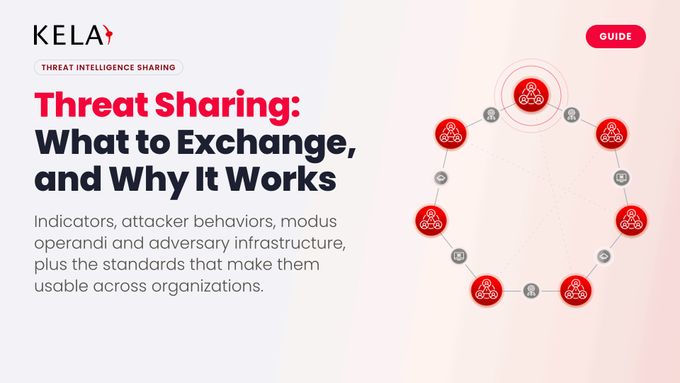
Threat intelligence sharing transforms how organizations defend against cyber attacks. Instead of fighting threats alone, businesses can tap into collective knowledge from peers, industry groups, and government agencies, turning individual insights into a powerful, shared defense. By combining real-time data, observed attacker behaviors, and sector-specific warnings, organizations can detect attacks faster, respond more effectively, and reduce the overall impact of threats. This collaborative approach strengthens both individual organizations and the wider industry ecosystem.
In this blog, we'll explore how threat sharing accelerates detection, supports proactive security, and strengthens defenses across entire industries.
» Strengthen your cybersecurity with KELA's expertise
Types of Intelligence and Shared Value
Exchanging different types of intelligence allows the collective defense to move faster than the adversary, transforming isolated events into actionable insights.
- Indicators of Compromise (IOCs): These offer immediate, tactical value by providing digital fingerprints like malicious IPs or hashes. Sharing them enables rapid, automated defense through firewalls and SIEMs, instantly blocking known threats and serving as a crucial first line of defense.
- Tactics, Techniques, and Procedures (TTPs): This is the attacker's playbook. Instead of just the fingerprints (IOCs), TTPs tell you how the attacker operates. Since attackers change their tools all the time but rarely change their overall strategy, building defenses around their behavior is a much smarter long-term plan. This also lets your own security team run realistic drills that mimic how real hackers think.
- Modus Operandi (MO): This is the attacker's signature style. Do they only work on weekends? Do they favor a certain industry? Understanding their habits helps you predict their next move and identify who you might be up against. It adds crucial context that turns raw data into predictive insight.
- Adversary Infrastructure: This is the attacker's home base—the command-and-control servers, botnets, and other systems they rely on to launch attacks. Sharing this information allows organizations to disrupt an attacker's entire operation at its source, not just block a single attack.
» Make sure you understand how threat actors breach and exploit your data
Putting It All Together
When you combine these intelligence types, you get a powerful, multi-layered security strategy:
- IOCs provide immediate, tactical blocks.
- TTPs build resilient, long-term defenses.
- Modus Operandi helps you anticipate the attacker's next move.
- Adversary Infrastructure identifies key choke points to disrupt their campaigns.
Together, they create a complete picture that strengthens your defenses and allows your offensive security teams to test them against what's actually happening in the wild.
» Learn more: Understanding the different types of cyber adversaries

Protect Your Organization
KELA helps you understand IOCs, TTPs, and adversary infrastructure so you can anticipate threats and protect your organization from emerging attacks.
Standardized Frameworks: Improving Clarity and Usefulness
Standardized frameworks like MITRE ATT&CK and STIX/TAXII solve the crucial "common language" problem in cybersecurity. Before these standards, attack descriptions varied vastly, causing confusion and hampering coordinated responses.
ATT&CK improves clarity by providing a globally recognized taxonomy to label specific adversary behaviors, such as T1059.001 for PowerShell execution, ensuring every organization describes the same action identically. This common vocabulary makes intelligence immediately understandable.
The STIX format and TAXII protocol enhance usefulness by providing the structured language and transport mechanism to share this information automatically. This combination of a common description standard and an automated sharing protocol ensures intelligence is ingestible by security tools across different enterprises. This dramatically increases the speed and efficiency of collaborative defense by moving beyond manual processes.
» Check out our guide on effective threat hunting with APT profiling and learn how to leverage the MITRE Framework for smarter defenses
The Impact of Threat Sharing on Security and Operations
Threat sharing is a force multiplier that transforms an organization's defensive posture from a solitary, reactive effort into a collaborative, proactive, and efficient strategy. The key impacts are felt across detection speed, operational efficiency, and overall resilience.
1. Accelerated Threat Detection and Response
Threat sharing significantly reduces the time it takes for an organization to identify and neutralize a cyber threat.
- Early warning system: Organizations receive pre-validated IOCs and TTPs from peers who have already experienced an attack. This allows security tools to be updated with new rules before the threat reaches their network.
- Reduced mean time to detect (MTTD): By leveraging external intelligence, Security Operations Center (SOC) teams can spot malicious activity much faster than relying solely on internal data, which translates directly to a faster time-to-containment and reduced damage.
» Learn more: Benefits of automating CTI into SOC activities
2. Enhanced Operational Efficiency and Prioritization
Sharing intelligence helps security teams move away from chasing noise and focus their efforts on verifiable threats.
- Reduced alert fatigue: Validated external intelligence enriches internal alerts, allowing analysts to quickly de-prioritize false positives and focus their limited time and expertise on the most relevant, high-fidelity threats.
- Informed resource allocation: Intelligence provides context on which vulnerabilities are actively being exploited in the wild. This allows the organization to prioritize patching and defensive spending (e.g., on tools, training) based on genuine, current risk rather than generic severity scores.
» Make sure you know the difference between a vulnerability, a threat, and a risk
3. Support for Proactive Security Practices
Threat intelligence moves a security program beyond simple incident response into a proactive, anticipatory defense model.
- Targeted threat hunting: Shared TTPs allow threat hunters to search the network for specific, known adversary behavior rather than conducting generalized, resource-intensive searches.
- Realistic red teaming: Red teams can design their attack simulations and adversary emulation drills using the actual campaigns currently being observed in the industry, making the training more effective and validating true defensive gaps.
» Understand why you need cyber threat intelligence for your organization
4. Collective Resilience and Sector-Wide Defense
When organizations in the same sector share intelligence, they create a "herd immunity" effect that raises the cost and complexity for attackers.
- Reduced attack surface: When one organization patches a flaw or blocks an IOC based on shared data, all other members are alerted to do the same. This swiftly removes widespread attack vectors, making the entire sector a harder, more costly target.
- Strategic defense: Cross-sector collaboration with national CERTs or critical infrastructure groups provides national-level visibility, allowing organizations to collectively defend against large-scale or state-sponsored campaigns that target multiple industries simultaneously.
5. Improved Trust and Governance Through Standardization
Using the Traffic Light Protocol (TLP) in threat intelligence sharing helps establish trust because it gives all participants a clear, standardized way to handle sensitive information. TLP assigns colors (Red, Amber, Green, and Clear) to indicate how widely data can be shared.
- Red means the information stays within the specific group or individuals.
- Amber limits sharing to within the recipient’s organization.
- Green allows sharing across a community but not publicly.
- Clear permits open sharing.
This system reassures participants that their contributions will not be misused or exposed beyond the intended audience. By reducing uncertainty and providing transparency about handling rules, TLP lowers the risk of accidental disclosure.
That reliability encourages organizations to be more open in contributing intelligence, knowing that partners will respect the agreed boundaries.
» Still confused? Here's everything you need to know about cyber threat intelligence
Strengthening Critical Infrastructure Through Intelligence Sharing
Intelligence sharing is vital for the resilience of critical infrastructure (CI) because these systems are highly interconnected, and an attack on one utility could cascade to others. Shared intelligence provides early warnings about threats targeting operational technology (OT) systems, allowing operators to proactively patch vulnerabilities or adjust security postures.
- Addressing fragmented ownership: A federated model, coordinated by a central body like a national CERT or sector-specific ISAC, helps standardize intelligence sharing across organizations of all sizes.
- Overcoming uneven security maturity: Central coordination provides tools, guidance, and standards, helping less mature partners improve their defenses.
- Enhancing sector-wide coordination: These partnerships ensure that all critical systems can respond collectively to threats, reducing the risk of cascading failures.
The World Economic Forum notes that such partnerships are crucial for enhancing the collective defense of a nation’s most vital services.
» Make sure you understand the role of a threat intelligence analyst
Meeting Regulatory and Compliance Obligations Through Threat Sharing
Participating in threat sharing helps you meet regulatory requirements like GDPR and HIPAA. It demonstrates proactive risk management, which can reduce liability after a breach.
- Demonstrating compliance: Sharing intelligence proves due diligence to regulators, showing you actively monitor and respond to threats.
- Reducing business risk: Collaborative security reduces the likelihood and impact of breaches, lowering potential financial and legal exposure.
- Building stakeholder trust: According to PwC’s Global Digital Trust Insights survey, companies that collaborate on security build stronger trust with customers and investors, improving reputation and confidence.
» Concerned about the future? See these other trends shaping the future of CTI or check out our future of cybercrime podcast
How KELA Can Help You
Threat sharing transforms security from a solitary effort into a collaborative defense strategy. By exchanging intelligence with peers and industry partners, your business can detect threats faster, prioritize defenses more effectively, and stay ahead of sophisticated adversaries.
KELA helps your business monitor cybercrime underground sources in real time, providing actionable threat intelligence from the attacker's perspective.
» Get started for free with KELA and strengthen your cybersecurity
FAQs
What types of threat intelligence are most valuable to share?
The most valuable intelligence includes IOCs for immediate blocking, TTPs for understanding adversary behavior, threat actor modus operandi for prediction, and adversary infrastructure for strategic disruption.
What is the Traffic Light Protocol and why does it matter?
TLP is a standardized system using color codes to indicate how widely threat intelligence can be shared, building trust by ensuring sensitive information stays within agreed boundaries.
How does threat sharing help with regulatory compliance?
Participating in threat sharing demonstrates proactive risk management to regulators, proves due diligence, and can reduce liability after a security incident.
Can small organizations benefit from threat intelligence sharing?
Yes. Federated models coordinated by CERTs or ISACs provide tools and standards that help organizations of all sizes participate and improve their defenses.
Who participates in threat sharing initiatives?
Participants typically include enterprises, critical infrastructure operators, CERTs, government agencies, and industry-specific Information Sharing and Analysis Centers (ISACs).