

CISO Checklist 2026: Threat-Informed Prep for the Year Ahead
Traditional perimeter defenses fail against agentic AI attacks that collapse network breakout times to 27 seconds. CISOs must pivot to a Resilience-First Framework built on the Minimum Viable Business (MVB), leveraging KELA's autonomous pre-breach intelligence to neutralize external exposures before they turn into internal intrusions.


Published September 2, 2026
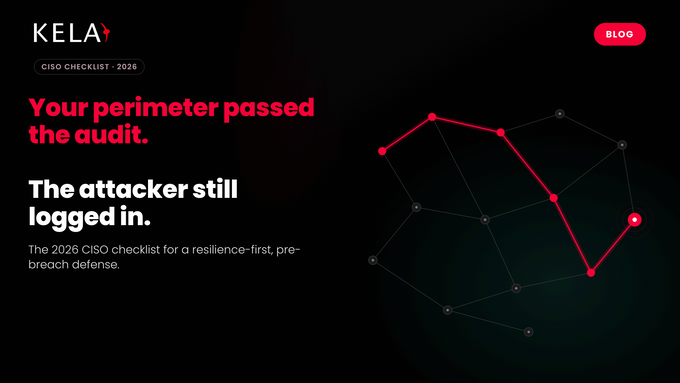
The shift from manual security processes to automated, machine-speed operations has altered the enterprise attack surface. In this modern operating environment, threat actors no longer need to break into an enterprise network through complex technical software exploits; instead, they exploit valid, compromised identities to log in directly. For security leaders, maintaining continuity requires transitioning from static, point-in-time administrative compliance checklists to continuous, proactive exposure management.
Relying on passive post-incident reporting guarantees defensive failure when facing adversaries capable of rapid, automated lateral movement. In this blog, we will explore the essential threat-informed preparations security leaders must implement to protect enterprise infrastructure and demonstrate how KELA Cyber provides the pre-breach intelligence required to validate and harden these critical corporate controls.
» Learn how KELA equips CISOs with actionable intelligence to continuously assess risk and protect critical business operations
The 2026 Threat Reality
Today's cyber threats have transitioned from technical annoyances to critical business risks that directly impact revenue and legal standing. As organizations navigate this landscape, the sheer scale of artificial intelligence has rewritten the rules of engagement.
To bridge this chasm, CISOs must address three recurring threat patterns that transcend industry verticals:
- Agentic AI exploits: Malicious actors deploy semi-autonomous and autonomous AI agents to probe networks, discover vulnerabilities, and weaponize weaknesses in near real-time. This velocity renders static defenses obsolete.
- Software supply chain fragility: Compromising a single upstream provider serves as a massive force multiplier for attackers, allowing them to spread laterally and compromise downstream organizations rapidly.
- Personal executive liability: Regulatory bodies are increasingly holding leadership personally accountable for systemic security failures. What was once managed as an operational incident is now a career-ending legal risk.
» Make sure you know the difference between a vulnerability, a threat, and a risk
Reframing the Security Checklist for Operational Resilience
To align security with enterprise objectives, CISOs must replace generic control inventories with a Resilience-First Framework. This approach prioritizes continuous operations and downtime prevention over administrative compliance.
The transition requires three strategic pivots:
- Map business exposure: Identify the top five operational dependencies that directly drive revenue or protect corporate reputation, shifting focus away from flat, uncontextualized vulnerability spreadsheets.
- Analyze adversary behavior: Implement Human Risk Management to continuously monitor behavioral patterns, such as phishing susceptibility, which fuels the majority of modern enterprise breaches.
- Measure outcome-based metrics: Replace passive activity metrics like "number of blocked emails" with business-centric indicators, specifically system uptime and risk reduction per dollar spent.
Executive Misunderstandings and the Governance Reset
Executive teams frequently conflate cybersecurity with cyber resilience. They treat security as a static defensive wall, mistakenly believing that high prevention spend eliminates the need for robust recovery planning. This leaves the enterprise highly vulnerable when a breach inevitably occurs.
To correct this before budget, audit, and board-planning conversations begin, CISOs must execute a three-part governance reset:
- Shift the narrative: Replace technical operational metrics like Mean Time to Detect (MTTD) with business-impact metrics like Maximum Tolerable Downtime (MTD). This aligns the security conversation directly with business continuity priorities.
- Quantify financial impact: Present concrete financial projections showing that prolonged downtime, rather than the initial intrusion, drives the bulk of breach costs.
- Conduct tabletop exercises: Run interactive simulations where active defenses are assumed to fail, forcing executives to make real-time trade-offs between recovery speed and data integrity.
» Read more: The CISO's guide to proactive cybersecurity
The Compliance Illusion: Real-World Exposure Failures
The danger of relying on static compliance is clearly illustrated by the classic Target breach. The retailer passed a comprehensive PCI-DSS security audit just weeks before its systems were compromised. The failure stemmed from unmanaged exposure regarding a third-party HVAC vendor who was granted excessive, unsegmented network access.
While the organization's compliance documentation was technically acceptable, it failed to account for how an adversary could exploit lateral movement across internal zones.
This systemic failure highlights three critical operational realities:
- Audits are Point-in-Time: Compliance confirms the presence of a control at a specific moment; it does not guarantee continuous operational security.
- Trust, but segment: Third-party access must strictly adhere to the Principle of Least Privilege to prevent localized vendor breaches from escalating into enterprise-wide crises.
- Active monitoring over passive logs: Security tools and logs are ineffective if alerts are drowned out by operational noise or ignored by security teams.
» Read more about protecting your organization from future cybercrime
The Threat-Informed CISO Checklist
As organizations face an increasingly hostile operating environment, defensive strategies must shift from passive compliance to proactive operational resilience.
The following preparations represent the essential operational blueprints security leaders must execute to protect enterprise continuity, corporate revenue, and executive governance.
1. Agentic AI Governance & Integrity
This preparation addresses the weaponization of autonomous AI agents by malicious actors who deploy them to discover system vulnerabilities and execute exploits in real-time. It targets AI-driven deception, prompt injection, and model tampering, which can corrupt automated corporate workflows and poison critical business decisions.
Consequences of Neglect
Neglecting this domain leads to an unmanaged expansion of "Shadow AI" across the enterprise, where lines of business deploy unvetted autonomous tools. This lack of oversight results in systemic data leaks, regulatory non-compliance, and unmonitored financial exposure.
How to Deploy This Preparation
- People: Train data scientists, software engineers, and system developers on Adversarial Machine Learning principles to recognize model vulnerabilities.
- Process: Embed specific AI risk assessments directly into existing corporate procurement, vendor onboarding, and technology governance lifecycles.
- Technology: Deploy dedicated AI firewalls, API gateways, and behavioral monitoring solutions optimized for tracking agentic and autonomous workflows.
- Executive oversight: Establish an AI Ethics & Risk committee at the board level to oversee algorithmic accountability and risk tolerance boundaries.
Operational Validation
Verify operational efficacy by conducting targeted AI red-teaming exercises that simulate adversarial prompt injections and synthetic identity injections, proving that human override capabilities reliably intercept compromised machine decisions.
» Did you know? Cybercriminals now exploit generative AI
2. Validated Ransomware Recovery (MVB Focus)
This checklist item counters large-scale, destructive ransomware attacks designed to paralyze enterprise infrastructure and compromise standard backup repositories.
It shifts the defensive posture toward the Minimum Viable Business (MVB), protecting the absolute baseline infrastructure required to sustain core operations and prevent total business failure.
Consequences of Neglect
Organizations that neglect MVB-focused recovery risk extended operational downtime that can disrupt revenue, erode customer trust, and weaken competitive positioning. Perimeter defenses alone cannot guarantee resilience; when prevention fails, the ability to recover quickly becomes the defining factor between a manageable incident and a business crisis.
How to Deploy This Preparation
- People: Formally appoint dedicated Recovery Owners for each business unit tied directly to an MVB service line.
- Process: Define precise recovery timelines mapped against validated financial loss thresholds and operational downtime tolerances.
- Technology: Implement cryptographically enforced, immutable, and physically or logically air-gapped backup architectures across all critical environments.
- Executive oversight: Deliver verified Time to Recover metrics directly to senior leadership during monthly operational governance reviews.
Operational Validation
Validate the recovery architecture by deploying Continuous Automated Red Teaming (CART) platforms to actively attempt to discover, access, and corrupt the designated immutable recovery environments.
» Here's how to build your ransomware response plan
3. Software Supply Chain "Confidence Scoring"
This addresses upstream supplier compromises where attackers infiltrate a trusted vendor to gain downstream access to your enterprise network. This preparation systematically counters supply chain vulnerabilities by evaluating the integrity of external software components.
Consequences of Neglect
Failing to secure the software ecosystem creates deep, unmonitored exposure within core operational environments. While 56% of technology leaders anticipate highly sophisticated supply chain exploits within their networks, only 22% possess comprehensive visibility into their third-party software dependencies, leaving the remaining majority vulnerable to silent, lateral intrusion.
How to Deploy This Preparation
- People: Align legal, procurement, and security teams to mandate comprehensive Software Bills of Materials (SBOMs) for all software acquisitions.
- Process: Establish a dynamic Confidence Level matrix to continuously score and re-evaluate critical digital suppliers.
- Technology: Integrate Cloud-Native Application Protection Platforms (CNAPP) within continuous integration pipelines to inspect vendor-provided code.
- Executive oversight: Conduct quarterly risk-concentration reviews at the executive level to evaluate dependencies on shared core code repositories.
Operational Validation
Confirm supply chain resilience by executing an emergency simulation modeled on the sudden, catastrophic compromise or total structural loss of a primary cloud infrastructure provider.
» Learn how supply chain threat intelligence strengthens your security posture
4. Machine & Non-Human Identity (NHI) Hardening
This preparation targets the rapid expansion of non-human identities, including application programming interfaces (APIs), service accounts, and automated scripts, which operate without traditional multi-factor authentication (MFA). It addresses credential theft and privilege abuse by enforcing strict, automated access boundaries.
Hardening these assets prevents attackers from exploiting orphaned machine credentials to move laterally through internal environments.
Consequences of Neglect
Neglecting non-human identities allows adversaries to compromise low-privilege service accounts and escalate access across production environments. Because these machine credentials outnumber human users, they represent an expansive attack surface.
How to Deploy This Preparation
- People: Assign explicit data owners and system stewards to every service account, API token, and automated script deployed.
- Process: Enforce structural Zero Trust architecture, requiring continuous cryptographic verification for every active machine identity.
- Technology: Deploy specialized Identity Threat Detection and Response (ITDR) platforms configured specifically to monitor non-human behavioral anomalies.
- Executive oversight: Track machine identity sprawl, anomalous service accounts, and stale credentials during executive risk committee sessions.
Operational Validation
Validate the identity structure by conducting automated audits of the Privilege Gap, measuring the divergence between assigned machine permissions and actual historical usage.
5. Post-Quantum Cryptography (PQC) Inventory
This defensive baseline counters "Harvest Now, Decrypt Later" operations, where nation-state actors exfiltrate encrypted corporate data with the intent of decrypting it when quantum computing architectures mature.
It addresses legacy cryptographic vulnerabilities by systematically locating and upgrading obsolete encryption algorithms. Implementing PQC protocols ensures long-term confidentiality for sensitive enterprise assets.
Consequences of Neglect
Neglecting the cryptographic transition leaves high-value data assets, such as intellectual property, long-term financial structures, and healthcare records, exposed to future decryption.
As quantum capabilities progress, data assets with extended operational utility become completely compromised if left secured by traditional asymmetric encryption methods.
How to Deploy This Preparation
- People: Form a multidisciplinary post-quantum migration task force combining security engineering, legal counsel, and data governance experts.
- Process: Classify corporate data assets based on operational lifespan, prioritizing information that must remain secure for over a decade.
- Technology: Run specialized discovery tools to build an inventory of cryptographic assets and locate hardcoded legacy encryption modules.
- Executive oversight: Secure formal board approval for a capitalized, multi-year cryptographic modernization and migration roadmap.
Operational Validation
Prove readiness by successfully deploying a validated post-quantum cryptographic encryption layer over an active, non-critical enterprise data pipeline without causing operational latency.
6. Geopolitical Disruption Rehearsals
This rehearsal framework prepares the enterprise for state-aligned cyber operations, regional infrastructure blackouts, and localized cloud isolation driven by international instability. It mitigates systemic dependencies on concentrated geographic regions by engineering alternative operational pathways.
This ensures that the organization maintains core business functions despite sudden international network fragmentation.
Consequences of Neglect
Failing to account for global instability results in disorganized, reactive corporate decision-making during international crises. When geopolitical risks are treated as abstract issues rather than direct inputs into business continuity plans, organizations suffer immediate supply chain blockades, localized service terminations, and regulatory compliance friction.
How to Deploy This Preparation
- People: Integrate regional geopolitical risk analysts directly into quarterly corporate security strategy and threat intelligence planning sessions.
- Process: Formulate explicit, actionable playbooks for regional cloud infrastructure isolation, sudden vendor terminations, and localized data sovereign blackouts.
- Technology: Engineer automated data sovereignty controls and geographic failover patterns across independent infrastructure regions.
- Executive oversight: Conduct active tabletop drills with the executive leadership team to align on risk thresholds and operational trade-offs.
Operational Validation
Validate resilience by measuring the Mean Time to Pivot (MTP), tracking exactly how long it takes the organization to shift critical operations from one geographic zone or infrastructure vendor to another during an unannounced drill.
Operationalizing Pre-Breach Intelligence with KELA Cyber
As autonomous, agentic AI accelerates the speed and scale of cyberattacks, traditional detection paradigms are becoming less effective. Relying on post-incident reporting means responding after an intrusion has already begun, leaving organizations with little time to contain the threat.
Driving Pre-Intrusion Visibility and Context
KELA shifts the enterprise defensive posture from internal remediation to external anticipation through three core structural capabilities:
- Adversary-visible signals: The platform continuously monitors deep and dark web marketplaces, closed criminal forums, and illicit communication channels. It identifies real-time Initial Access Broker (IAB) listings, exposed session cookies, network infrastructure targets, and credential dumps specifically tied to the enterprise digital footprint.
- Contextualized relevance: Rather than inundating security operations teams with unfiltered, generic threat feeds, KELA applies specialized profiling algorithms to correlate external underground data directly with an organization's specific active assets.
- Operational resilience integration: By integrating directly into existing SIEM and SOAR engineering workflows, KELA enables automated, proactive countermeasures. Security teams can execute targeted credential revocations and invalidate compromised session cookies before external exposures escalate into active enterprise incidents.
Strengthening the Resilience Checklist
Integrating external threat intelligence into core governance processes allows security leaders to transition administrative compliance checklists into active, adversary-validated defenses.
Attack-Surface Validation
Instead of relying strictly on scheduled internal vulnerability scans, security teams utilize KELA’s specialized intelligence modules to monitor dark web marketplaces for active Initial Access Broker (IAB) listings.
When compromised Remote Desktop Protocol (RDP) instances or Virtual Private Network (VPN) credentials associated with enterprise assets appear on criminal forums, the system triggers immediate, prioritized remediation to close the specific exposure vector before an intrusion occurs.
SOC 2 Compliance Verification
During formal SOC 2 audits, KELA’s continuous monitoring serves as a primary evidentiary control for Risk Assessment and Logical Access criteria. Rather than relying on generic policy statements, the organization provides auditors with documented proof of active, real-time detection and remediation regarding compromised employee accounts.
Third-Party Supply Chain Protection
Security teams leverage KELA’s ecosystem tracking to evaluate the external threat profile of critical vendors. If a high-impact software supplier appears on an active ransomware data-leak portal, the organization can initiate its targeted Minimum Viable Business (MVB) continuity playbooks immediately, bypassing the latency associated with manual, quarterly vendor risk assessments.

Security Before the Breach
KELA helps security leaders identify exposures, validate controls, and stop threats before they become breaches.
» Not convinced? Here are the reasons you need cyber threat intelligence
How KELA Cyber Secures the 2026 Resilient Enterprise
Navigating an adversarial landscape defined by autonomous AI agents, fragile supply chains, and industrial credential marketplaces requires more than administrative compliance.
KELA Cyber directly empowers this operational shift. By delivering automated, high-fidelity pre-breach intelligence, KELA transforms external adversary activity into actionable internal defense modifications. From attack-surface validation and active compliance proof to supply chain situational monitoring, KELA provides the visibility needed to stop intrusions before they penetrate the internal network perimeter.
» Ready to get started? Contact us to learn more about our cyber threat intelligence services
FAQs
Why are traditional perimeter security controls failing?
Traditional perimeter defenses are falling short because threat actor behavior has shifted away from discovering and exploiting software vulnerabilities toward industrial-scale credential theft and identity abuse.
What is a Minimum Viable Business (MVB) framework in ransomware recovery?
An MVB framework isolates the absolute baseline services, data pipelines, and infrastructure required to keep an organization operationally alive during a catastrophic ransomware encryption event.
Rather than wasting time trying to restore flat, uncontextualized spreadsheets of all enterprise assets at once, an MVB strategy focuses strictly on preserving core revenue-generating systems and protecting corporate reputation.
Why is Mean Time to Detect (MTTD) losing relevance for boards?
MTTD measures a technical operational timeline, which does not convey business impact. Boards prioritize Maximum Tolerable Downtime (MTD), which quantifies the exact financial and operational limits an enterprise can survive before suffering severe material damage.
What is breakout time, and why does it matter for CISOs in 2026?
Breakout time is the gap between an attacker's initial access and their first lateral move to another system. CrowdStrike's 2026 report put the 2025 average at 29 minutes, with the fastest at 27 seconds. The shorter that window, the less time defenders have to detect and contain an intrusion, which is why static, point-in-time defenses no longer hold.
What is a Resilience-First Framework?
It's a security approach that prioritizes keeping the business running over passing administrative compliance checks. Instead of flat vulnerability inventories, it maps the operational dependencies that drive revenue, monitors adversary behavior continuously, and measures outcomes like system uptime and risk reduction rather than activity counts.
Why isn't passing a compliance audit enough?
Audits confirm a control existed at a single point in time; they don't guarantee continuous security. The Target breach is the classic example: the retailer passed a PCI-DSS audit weeks before attackers used a third-party vendor's network access to move laterally and compromise its systems.
What is pre-breach intelligence?
Pre-breach intelligence is external visibility into adversary activity (leaked credentials, Initial Access Broker listings, exposed session cookies) before that activity turns into an internal intrusion. It shifts the defensive posture from responding after a breach to intercepting exposures while they're still external.