

How Secure Is Cloudflare WARP?
How secure is Cloudflare WARP? Very, for data in transit: it encrypts the connection from the device to Cloudflare's network and shuts down local network attacks like packet sniffing, rogue access points, and DNS hijacking. What it cannot do is tell a real employee from an attacker holding a valid password, or spot malware already running on the endpoint. This piece maps exactly where the tunnel ends and what has to cover the rest.



Published September 4, 2026
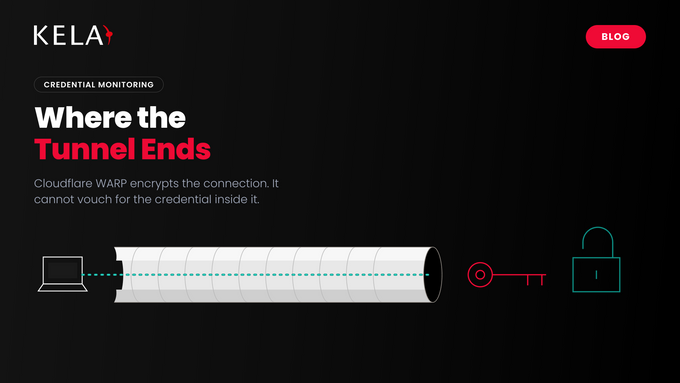
Cloudflare WARP has transformed the way modern enterprises handle remote connectivity by providing a high-speed, encrypted "on-ramp" for the distributed workforce. This tool effectively replaces the bottlenecked, legacy VPN architecture with a streamlined tunnel that shields data from local network threats and interception.
However, the security of a tunnel is only as strong as the identity of the person using it and the health of the device at the end of the line. Navigating the balance between seamless access and robust defense requires a deep understanding of where network encryption ends and proactive threat intelligence must begin.
» Strengthen your cybersecurity with KELA's expertise
What is Cloudflare WARP?
Cloudflare WARP is a security tool designed to make the internet faster and more private. At its core, it is a secure VPN. However, it operates differently than the old-school VPNs you might be used to.
While a traditional VPN simply hides your IP address, WARP uses Cloudflare's massive global network to route your traffic. Cloudflare sits in front of a large share of the web, roughly one in five of all websites as of January 2026 according to W3Techs, and when you access a site on its network, WARP fetches that content almost instantly.
Who Is Cloudflare WARP Best For?
For businesses using Cloudflare's platform, WARP is the essential link that turns the core Zero Trust principle of "never trust, always verify" into a reality for their workforce.
The WARP product is most effective for:
- Individual users: People looking for a fast way to encrypt their data on public Wi-Fi without the speed loss of typical VPNs.
- Remote and hybrid workforces: Companies that need to give employees secure access to internal tools from any location without managing heavy hardware.
- Security-conscious organizations: Businesses that want to verify device "posture" (like checking if a laptop is encrypted) before allowing a connection.
Where WARP might be a poor fit:
- Strict data residency: Some organizations have legal mandates requiring all data processing to stay within specific borders. Because WARP routes traffic to the nearest global data center, it might move data across countries.
- Legacy protocols: Organizations relying on very old or non-standard network protocols may find WARP a poor fit, as it is optimized for modern, IP-based web traffic.
- Full anonymity seekers: Unlike some commercial VPNs designed to hide your identity for certain activities, WARP focuses more on security and speed than on total location masking.
» Learn more: The role of a threat intelligence analyst
Traditional VPN vs. Full Zero Trust (ZTNA)
Feature | Traditional VPN | Full Zero Trust (ZTNA) |
|---|---|---|
Primary Trust Model | Trust but verify: Once the "moat" is crossed, the user is trusted. | Never trust, always verify: No user or device is trusted by default. |
Access Granularity | Network-level: Grants a tunnel to entire internal subnets. | Application-level: Grants access to specific apps only (Microsegmentation). |
Verification | Static: Checks credentials once at the start of a session. | Continuous: Checks identity, device health, and context constantly. |
Lateral Movement | High risk: Attackers can move easily across the flat network. | Minimal risk: Access is segmented; if one app is hit, others stay dark. |
Performance | Backhauled: Traffic is often sent to a central office before the web. | Edge-based: Traffic connects to the nearest global data center. |

Cyber Threat Intelligence
Use KELA’s threat intelligence insights to detect early signs of data breaches and third-party exposure that Cloudflare WARP’s encryption alone cannot see.
Evaluating Cloudflare WARP’s Security Posture
Cloudflare WARP is a powerhouse for securing data in motion, but it is not a silver bullet. Understanding where it builds a digital fortress and where the gates remain open is essential for any modern security operations center (SOC).
Authentication and Credential Protection
Cloudflare WARP acts as a high-strength shield for your credentials while they are traveling from a device to the cloud.
- Secure transmission: WARP encrypts the connection from the device to Cloudflare's network, which prevents an attacker sitting on the local network from reading login data out of the traffic.
- Phishing mitigation: When paired with Cloudflare Gateway, it automatically blocks known phishing domains. This stops many attacks before a user ever has the chance to enter their password on a fake site.
» Learn more: How scary is that data leak, really?
Network-Level Protection and Endpoint Limitations
Cloudflare WARP acts as a significant shield against threats that happen in transit, protecting data as it moves across the internet. By routing all traffic through an encrypted tunnel to Cloudflare's network, it provides robust protection against:
- DNS hijacking: Attackers cannot redirect your requests to malicious servers because WARP ensures DNS queries go securely to Cloudflare’s own resolvers.
- Packet sniffing: On unencrypted networks like public Wi-Fi, WARP’s encryption makes your data packets unreadable to anyone trying to capture them.
- Rogue Wi-Fi access points: Even if a user connects to a fake hotspot, WARP encrypts the traffic immediately, preventing the attacker from seeing the data.
Securing Remote Teams and Third-Party Partners
WARP excels in securing remote employees, contractors, and supply chain partners by encrypting device traffic and enforcing DNS and HTTP filtering. This drastically reduces exposure to phishing sites and insecure connections.
When integrated with Cloudflare Access, it allows for conditional policies that restrict application use to only compliant, healthy devices.
The remaining exposure: Despite these strengths, organizations remain exposed to:
- Compromised credentials: If an attacker has valid credentials, they can walk through the secure tunnel undetected.
- Unmanaged devices: Contractors using personal, infected PCs might inadvertently send stolen data through the encrypted WARP connection.
- Ransomware risk: WARP helps prevent the initial download, but it lacks the deep behavioral analysis to stop a ransomware attack already in progress on the device.
» Make sure you understand the difference between leaked credentials and compromised accounts
Organizations can maintain visibility into these risks without undermining the privacy benefits of WARP. Instead of using invasive deep packet inspection, teams should focus on metadata and endpoint telemetry.
By ingesting WARP’s DNS and access logs into a SIEM, analysts can correlate them with identity events to spot anomalies, such as a contractor logging in from an unusual geography.
Correlating that with KELA's monitoring of compromised credentials across infostealer logs, third-party breach data, underground markets, and hacking forums gives the SOC the context to act on a valid-looking login before it becomes an incident. This layered approach preserves the privacy of the connection while giving the SOC the data they need to catch compromised accounts and ransomware precursors.
» Dive deeper with our guide to navigating third-party risks
Fighting Ransomware and the "Stolen Credential" Blind Spot
Cloudflare WARP is a powerful tool for stopping common ransomware attacks before they begin. Its primary strength is encrypting all traffic from the device to the Cloudflare network, preventing data interception on risky Wi-Fi.
When paired with Cloudflare Gateway, it uses DNS filtering to block connections to known malicious domains and "Command and Control" (C2) servers.
Limitations of WARP:
- Stolen credentials: It cannot distinguish between a real employee and a hacker using a valid password.
- The "Walk-In" attack: Attackers with stolen credentials bypass network security because they appear as legitimate users.
- Behavioral blind spot: It lacks the deep analysis needed to detect malicious activity once a session is already authenticated.
» Read more: How to detect password leaks and stolen credentials
Using Intelligence to Close the Gap
To address these gaps, security teams should combine WARP with specialized threat intelligence like KELA Cyber:
- Dark web monitoring: Matches your domains, SaaS tenants, IP ranges, and executive email addresses against compromised accounts in KELA's data lake, in real time and retroactively across historical data, so you can force a password reset before the credential is used.
- Adversary tracking: Builds out profiles of the actors and groups relevant to your sector, including their handles across platforms, their TTPs mapped to MITRE ATT&CK, and the sources they operate in, so you know who is likely to come at you and how.
- Proactive alerts: Raises an incident when your assets are named in posts on dark net forums, markets, paste sites, and instant messaging channels, which is where access is advertised for sale, so you can harden defenses ahead of a payload.
» Learn about five trends shaping Initial Access Broker activity
Cloudflare WARP’s Role in Modern Security
How should an organization ultimately define Cloudflare WARP? It sits between being a simple privacy tool and a complete security suite, serving a specific purpose in the modern "work from anywhere" world.
The Integrated Connectivity Hub
Cloudflare WARP is best viewed as a secure on-ramp that establishes a robust starting point for a Zero Trust framework. It is more than a connectivity enhancer because its core function is to create a mandatory, encrypted "tunnel" for all network traffic, regardless of where the employee is located.
Why organizations use it as a starting point:
- Encrypted entryway: It immediately neutralizes threats like DNS hijacking and Wi-Fi sniffing.
- Policy enforcer: It acts as the "hands" for Cloudflare Access, enforcing rules based on who the user is before they can touch an application.
- Universal coverage: It provides a consistent security layer across mobile devices and laptops that traditional VPNs often struggle to manage.
Critical Gaps: What WARP Doesn't Do
To avoid overestimating your protection, it is vital to recognize where WARP’s "tunnel" ends and other security needs begin:
- Content & data blindness: WARP handles the delivery of data, but it doesn't natively provide deep Data Loss Prevention (DLP) or advanced file sandboxing to stop sensitive leaks.
- Limited posture depth: It can check if a device is "managed," but it cannot replace an EDR for detecting active ransomware execution or file-less malware.
- The identity vulnerability: It secures the path, but it cannot stop an attacker who has already stolen a valid password or session token.
» Make sure you know the difference between a vulnerability, a threat, and a risk
The Verdict: A Multi-Layered Strategy
The takeaway is that WARP is a transport control, and transport is only one of the three layers an attacker has to get through.
The true value of WARP is unlocked only when it is integrated with other specialized tools. To build a complete defense, organizations must layer their strategy:
- Transport: Use WARP for the secure, encrypted tunnel.
- Identity: Use Dark Web Monitoring to ensure the credentials entering that tunnel haven't been leaked or sold on criminal forums.
- Endpoint: Use an EDR to monitor the device itself for hostile activity that encryption might otherwise hide.
» Understand why you need cyber threat intelligence for your organization
Advanced Cyber Threat Intelligence
KELA's advanced cyber threat intelligence helps you identify and mitigate automotive industry threats so you can focus on growing your business.
How KELA Cyber Can Help
KELA Cyber provides the critical intelligence layer that transforms Cloudflare WARP into a proactive defense system. While WARP secures the path, KELA monitors the criminal underground to ensure employee credentials haven't been compromised or sold to initial access brokers.
By feeding KELA’s real-time dark web alerts directly into Cloudflare policies, organizations can automatically block compromised accounts before an attacker enters the network. This threat intelligence closes the visibility gap, allowing your SOC to neutralize threats that encryption alone would otherwise hide.
» Get started for free with KELA and strengthen your cybersecurity
FAQ's
Is Cloudflare WARP a replacement for a traditional VPN?
Yes. It provides faster, more reliable encryption and integrates with Zero Trust policies, though it doesn't offer "geo-spoofing" like some consumer VPNs.
Does WARP protect my device from malware?
Partially. It can block connections to known malware "Command and Control" (C2) servers via DNS filtering, but it cannot detect a virus already on your hard drive.
What is the difference between WARP and Cloudflare Access?
WARP is the "on-ramp" (the secure tunnel), while Cloudflare Access is the "brains" (the gatekeeper) that checks identity and device health.
Does WARP affect my internet speed?
Usually, it makes it feel faster. It uses Cloudflare’s global network to find more efficient paths to websites than a standard ISP.