

Dark Web Monitoring: A Critical Component of Modern Cybersecurity
A practical breakdown of the surface, deep, and dark web, how threat actors monetize stolen corporate data, and why proactive dark web monitoring has become essential to detecting breaches early and reducing their impact.




Published September 2, 2026
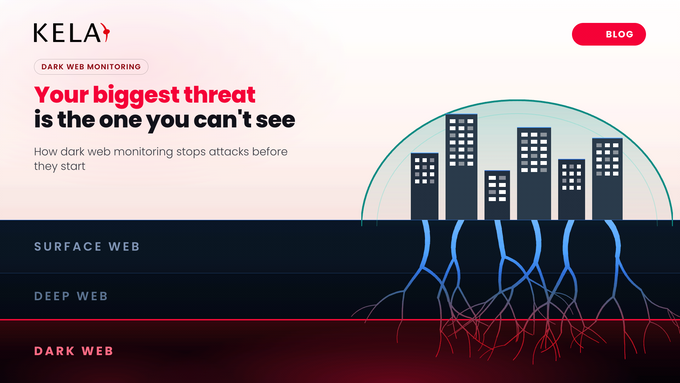
`The greatest threat to your organization’s cybersecurity isn't what you can see, it’s what is being traded in the shadows. Beneath the visible internet lies the dark web: an encrypted ecosystem where cybercrime has evolved into a sophisticated, multi-billion dollar service economy. Here, Initial Access Brokers and Ransomware-as-a-Service (RaaS) syndicates actively weaponize stolen corporate data, turning a single compromised employee credential into a full-scale corporate crisis. To defend your perimeter, you must understand the marketplace operating against it.
This guide breaks down how cybercriminals leverage the dark web, the real-world consequences for enterprises, and how proactive dark web monitoring can neutralize threats before an attack ever begins.
» Skip to the solution: Try KELA's cyber threat intelligence for free
What Is the Dark Web?
The dark web is widely used by cybercriminals as a marketplace and coordination space for tools, services, and stolen data that support large-scale attacks against organizations.
To understand the scale of this underground economy, it is essential to look at the primary ways threat actors exploit it, including the monetization of corporate access, automated attack tools, and underground data trading:
Cybercrime-as-a-Service (CaaS)
The dark web has enabled cybercrime to evolve into a structured service economy. Threat actors sell or rent ransomware kits, phishing platforms, malware loaders, and exploit frameworks through subscription-style models. Ransomware-as-a-Service operations allow affiliates to launch attacks without advanced technical expertise, while operators receive a percentage of ransom payments.
This business model lowers the entry barrier for cybercrime and significantly increases the scale, frequency, and sophistication of attacks targeting organizations globally.
» Here are the most targeted entry points by hackers
Initial Access Brokers (IABs)
Initial Access Brokers specialize in compromising organizations and selling network access on dark web forums. These actors commonly obtain access through stolen VPN credentials, exposed remote desktop services, phishing attacks, or unpatched vulnerabilities.
Once access is secured, it is sold to ransomware groups or other attackers looking for rapid entry into corporate environments. This specialization streamlines cybercrime operations and accelerates the execution of large-scale attacks against enterprises.
Stolen Data Marketplaces
Dark web marketplaces host massive volumes of stolen credentials, personally identifiable information (PII), financial records, and corporate data. Cybercriminals purchase this information to conduct identity theft, phishing campaigns, fraud, and further intrusions.
The availability of billions of compromised records creates a highly profitable underground economy that continuously fuels cybercrime activity. Organizations impacted by breaches often face long-term exposure as stolen information remains traded long after the original incident.
AI-Enhanced Cybercrime Tooling
Cybercriminals increasingly use artificial intelligence to automate and improve attack execution. AI-powered tools can generate convincing phishing emails, automate malware development, create deepfake voice impersonations, and improve credential harvesting campaigns.
These capabilities allow attackers to scale operations rapidly while reducing the technical effort required to conduct sophisticated attacks. AI-enhanced tooling also increases the success rate of social engineering campaigns targeting employees, executives, and third-party vendors.
» Make sure you know the differences between vulnerabilities vs. threats vs. risks

Defend Against Darknet Threats
Mitigate risks from illicit activities on darknet markets and safeguard your organization from cybercriminals operating in hidden online spaces.
Comparison of the Surface Web, Deep Web, and Dark Web
The Surface Web, Deep Web, and Dark Web operate in different ways in terms of visibility, access, structure, user activity, and risk exposure.
Category | Surface Web | Deep Web | Dark Web |
|---|---|---|---|
Structure | Public websites indexed by search engines using standard HTTP/HTTPS protocols. | Private systems such as databases, cloud platforms, and internal portals not indexed by search engines. | Encrypted overlay networks like Tor that use multi-layer routing to conceal identity and location. |
Access | Accessible through standard browsers without restrictions. | Accessible through regular browsers but requires logins, subscriptions, or direct URLs. | Requires specialized tools like Tor Browser to access hidden “.onion” sites. |
User Behavior | Everyday activities such as browsing, shopping, social media, and entertainment. | Private or restricted activities like banking, email, corporate systems, and academic access. | Mixed use including privacy-focused communication and illicit activities such as data trading and cybercrime. |
Risk and Impact | Lower risk due to visibility and active monitoring. | Moderate risk due to sensitive data behind authentication. | High risk involving cybercrime, data leaks, fraud, and major organizational impact. |
» Here are the top 8 deep web and dark web forums
Real-World Consequences for Organizations
Cyber activity linked to the dark web can lead to severe and wide-ranging consequences for organizations, impacting operations, finances, reputation, and legal standing.
- Multi-extortion and data leaks: Ransomware groups often steal data before encrypting systems and then publish it on dark web leak sites if victims refuse to pay. This results in exposure of intellectual property, trade secrets, and customer information, leading to operational disruption, reputational harm, and long-term business damage.
- Significant financial losses: Organizations affected by cyber incidents face high costs, including ransom payments, downtime, recovery efforts, legal fees, and system restoration.
- Reputational damage and business impact: Data breaches reduce customer trust and damage brand reputation. Many clients may move to competitors after an incident, and some organizations, especially smaller ones can struggle to recover from the loss of revenue and confidence following a major attack.
» See our complete guide to combating ransomware
Why Dark Web Monitoring Has Become Critical
Dark web monitoring has become an essential part of modern cybersecurity because it enables organizations to detect exposed data and emerging threats early, before they develop into full-scale security incidents.
- Early detection of compromised credentials: Dark web monitoring helps organizations identify leaked employee credentials, session tokens, and customer information before attackers can exploit them. Security teams can respond by resetting passwords, revoking access, and strengthening authentication controls, reducing the risk of account takeovers and unauthorized system access.
- Preventing ransomware and data extortion: Ransomware groups often leak samples of stolen data on dark web sites before launching full extortion attempts. Monitoring these channels provides early warning signs that an organization may already be compromised, allowing teams to isolate affected systems and address vulnerabilities before attacks escalate.
- Supply chain risk management: Dark web monitoring can reveal compromised vendor credentials, leaked third-party data, or discussions involving suppliers. This allows organizations to assess third-party risk more effectively, restrict compromised access, and reduce the likelihood of attackers entering through trusted external partners.
- Reduced dwell time and financial impact: By detecting exposed data or compromise indicators earlier, dark web monitoring reduces the time attackers remain undetected within systems. Faster detection leads to quicker incident response, lower downtime, and reduced financial impact from breaches that would otherwise escalate over time.
- Protection against brand abuse and phishing: Cybercriminals often create fake websites, phishing pages, and impersonation campaigns targeting organizations. Monitoring the dark web helps identify these threats early so they can be taken down before they are used to deceive customers or employees, reducing fraud and reputational harm.
- Intelligence-driven security operations: Dark web monitoring provides external threat intelligence on attacker activity, exposed data, and emerging threats. This gives security teams visibility beyond internal systems and supports more informed prioritization of risks, enabling proactive mitigation before incidents develop into major breaches.
» Learn more: The role of a threat intelligence analyst
Common Pitfalls in Dark Web Monitoring (and How to Address Them)
Organizations often face operational challenges after deploying dark web monitoring tools, especially when managing alert volume, interpreting intelligence correctly, and balancing automation with human oversight.
Pitfall | Description | How to Address |
|---|---|---|
Alert fatigue from excessive low-value alerts | Organizations can become overwhelmed by high volumes of alerts, many of which are irrelevant or low risk, leading to missed or ignored critical threats. | Tune alert thresholds, apply AI-based filtering, and prioritize findings using risk scoring and business impact to reduce noise and focus on high-confidence threats. |
Misinterpretation of dark web intelligence | Security teams may mistake general chatter or outdated information for active threats, resulting in unnecessary escalation and wasted resources. | Enrich alerts with contextual intelligence, validate sources, and train analysts to differentiate between noise, reconnaissance activity, and real exploitation. |
Over-reliance on automation | Heavy dependence on automated systems can lead to missed context or incorrect responses in complex or nuanced threat scenarios. | Implement a human-in-the-loop model where analysts validate high-risk alerts before action is taken to ensure accuracy and appropriate response. |
6 Key Capabilities to Prioritize in Dark Web Monitoring Tools
1. Comprehensive Source Coverage
Organizations should prioritize tools that monitor a wide range of sources, including forums, marketplaces, paste sites, botnet logs, and encrypted channels like Telegram.
Coverage should include:
- Infostealer logs and credential dumps as they often contain real-time, actively usable account access data.
- Leaked usernames, passwords, and session tokens that can enable immediate account compromise if not detected.
- A broad range of underground sources to improve early detection before stolen data is actively exploited.
- Emerging breach datasets and leak sites where newly exposed organizational data is first published.
» Learn more: Is Telegram safe to use?
2. Automated Alerts & Contextual Intelligence
Effective tools must deliver automated alerts that are enriched with context rather than raw data. Alerts should include threat actor information, data type, and potential impact on the organization.
3. Threat Correlation & Enrichment
Security platforms should correlate data from multiple underground sources to build a unified threat picture. Advantages of threat correlation and enrichment include:
- Provides a unified view of threats by linking data from multiple underground and open sources into a single intelligence picture.
- Helps identify coordinated attack campaigns by connecting stolen data, attacker profiles, and observed tactics across different platforms.
- Improves decision-making by adding context to alerts, such as threat actor history, targeting patterns, and likely intent.
- Reduces false positives by filtering isolated or low-relevance indicators and focusing on meaningful threat relationships.
- Enables earlier detection of complex attacks by revealing patterns that would be missed when analyzing data in isolation.
» Understand how threat actors breach and exploit your data
4. Surface-to-Dark Web Integration
Tools should connect external attack surface data with dark web intelligence to provide a unified view of exposure and potential compromise paths. This includes:
- Linking leaked credentials, exposed domains, and vulnerable assets to active dark web activity.
- Showing how real-world exposures translate into potential attacker entry points.
- Helping prioritize risks based on what is already being targeted or discussed by threat actors.
5. Automated Response & Workflow Integration
Integration with security and IT systems ensures that detected threats are acted on quickly and consistently. This includes:
- Connecting with SIEM, SOAR, and ITSM platforms for seamless incident handling.
- Automating actions such as ticket creation, credential resets, and account lockouts.
- Reducing response time through predefined and repeatable response workflows.
6. Human Intelligence & Disruption Capabilities
Effective platforms combine automation with analyst expertise to handle complex threats and actively disrupt malicious activity. This includes:
- Analyst-driven investigation of high-risk or closed underground sources.
- Deeper visibility into encrypted channels, forums, and threat actor ecosystems.
- Support for takedowns of phishing sites, leaked data, and impersonation infrastructure.
» Find out if darknet markets are going out of business, and what will happen next
How KELA Cyber Addresses These Capabilities
KELA Cyber delivers dark web monitoring through real-time intelligence collection across closed forums, marketplaces, botnet ecosystems, and encrypted channels like Telegram. The platform also maps external attack surfaces, tracks stolen credentials, and profiles threat actors to provide deeper context behind exposures.
What distinguishes KELA is its attacker-centric intelligence model and access to exclusive underground sources that are not widely indexed by other tools. Instead of presenting generic alerts, it prioritizes curated, validated “real” threats and integrates directly into SIEM and SOAR systems for operational response.
» Ready to get started? Contact us to learn more about our cyber threat intelligence services
FAQs
What is the dark web in simple terms?
The dark web is a hidden part of the internet that is not indexed by search engines and requires specialized tools like Tor to access.
It operates on encrypted networks designed to anonymize users and is used for both legitimate privacy-focused communication and illegal cyber activities.
How is the dark web different from the deep web and surface web?
The surface web is publicly accessible and indexed by search engines, the deep web contains private systems like databases and login-protected platforms, and the dark web runs on encrypted networks that hide identity and require special software to access hidden sites.
Why is the dark web important in cybersecurity?
The dark web is important because it is often used to trade stolen data, credentials, and hacking tools. Monitoring it helps organizations detect exposures early, understand attacker activity, and reduce the risk of breaches escalating into larger incidents.
How do cybercriminals use the dark web?
Cybercriminals use the dark web to sell ransomware tools, buy stolen data, trade access to compromised networks, and coordinate attacks. It functions as an underground marketplace that supports and scales global cybercrime operations.
What is dark web monitoring?
Dark web monitoring is the continuous scanning of dark web forums, marketplaces, and encrypted channels to detect when your organization's data, credentials, or access is exposed or being traded, so you can act before it's exploited.
What is the difference between the deep web and the dark web?
The deep web is any content behind a login or paywall, like online banking or corporate systems, and is perfectly legitimate. The dark web is a small, encrypted subset that requires tools like Tor to access and is commonly used for trading stolen data and cybercrime services.
How does dark web monitoring work?
It collects intelligence from underground sources such as forums, marketplaces, paste sites, botnet logs, and channels like Telegram, then alerts your security team when relevant data, such as leaked employee credentials, appears.
Can dark web monitoring prevent ransomware?
It can't stop an attack outright, but ransomware groups often leak stolen data or sell network access before an attack escalates. Spotting those early signals gives teams time to reset credentials, isolate systems, and respond before full extortion begins.
Is it illegal to access the dark web?
Accessing the dark web itself is legal in most countries, since the underlying technology is also used for privacy and legitimate communication. Buying stolen data or illegal goods is what crosses the line.
What kind of data is most traded on the dark web?
The dominant category is infostealer logs: data packages pulled from infected devices that bundle saved passwords, session cookies, autofill details, credit card numbers, and crypto wallet files in a single dump. Alongside these, the most traded items are session tokens (valued because they bypass MFA), corporate network access sold by Initial Access Brokers, personally identifiable information (PII), and financial records. KELA tracked 2.86 billion compromised credentials circulating across criminal markets in 2025.
What types of data are found on the dark web?
The dark web hosts a wide range of stolen and illicit data. The most common categories are login credentials and infostealer logs, session tokens, corporate network access, personally identifiable information (PII) such as names and dates of birth, financial records like credit card and bank details, healthcare data, and full breach databases dumped from a single organization. Beyond stolen data, marketplaces also trade malware, ransomware kits, crypto wallet files, and forged documents.