

Stealer Logs and Data Breaches: How to Build a Proactive Defense
Stealer logs are structured files of credentials, session cookies, and payment data harvested from infected devices. They let attackers sign in as your users instead of breaking in. This guide covers the endpoint, identity, cloud, and intelligence controls that reduce that exposure.




Published September 16, 2026
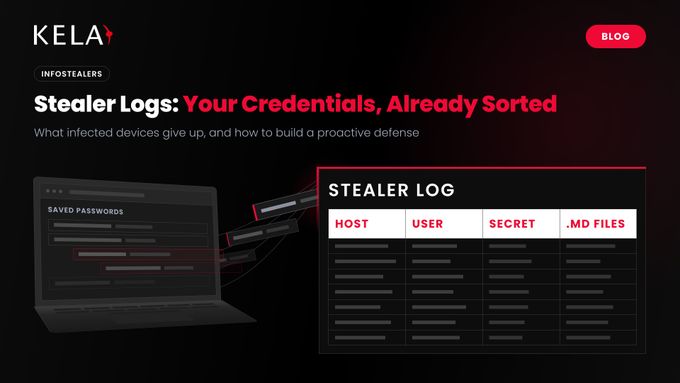
Your organization handles sensitive data across endpoints and cloud environments every day, making it a prime target for cybercriminals who collect and exploit stealer logs. Protecting credentials, tokens, and access to cloud systems is essential to maintain smooth operations and reduce risk.
In this blog, we will explore practical strategies to secure your business, from layered defense and identity management to monitoring threats in the underground cybercriminal ecosystem, helping your organization stay ahead of potential breaches.
» Get started for free with KELA and strengthen your cybersecurity
What Are Stealer Logs and What Data Do They Expose?
Stealer logs are records of sensitive information captured by malware from infected devices. When a device is compromised, it’s essentially being stripped for parts. These malware strains quietly collect anything that can be reused, sold, or abused.
Cybercriminals use this information to access accounts, exploit cloud systems, and steal money or sensitive business data. In short, stealer logs act as a digital inventory of everything an attacker can weaponize against your organization.
» Here's everything you need to know about infostealers
Common Categories of Data Found in Stealer Logs
- Browser credentials and autofill data: This includes saved usernames, passwords, and form data. Once abused, attackers can immediately take over email, social media, and work-related accounts.
- Session cookies and authentication tokens: Cookies allow attackers to bypass login screens entirely, giving them instant access even without knowing the password.
- Financial and payment information: Credit card details and banking data can be used for direct fraud or sold quickly on underground markets.
- Cryptocurrency wallets and private keys: Stolen private keys often result in permanent financial loss, as crypto transactions cannot be reversed.
- Browsing history and user metadata: This data helps adversaries build detailed victim profiles, enabling targeted scams and follow-up attacks.
The risk is severe because the window is short. Reporting on the infostealer supply chain describes logs being exfiltrated, validated against live services, and listed for sale inside roughly 48 hours of infection, which is well before most organizations know a device was compromised.
» Don’t overlook the real threat—learn how infostealers put your data at risk
How Adversaries Extract and Scale Stealer Log Data
Once a device is infected, the malware automatically collects sensitive data from browsers, applications, and local storage. This information is then exfiltrated to an attacker-controlled command-and-control (C2) server. Instead of leaving the data messy, adversaries organize it into structured stealer logs, often using simple formats that are easy to search and filter.
At scale, this process is powered by Malware-as-a-Service platforms. These services provide dashboards that allow attackers to manage infections, sort logs, and flag high-value victims with almost no technical effort.
» Here are the top 5 data leak forums in the cybercrime underground market
How to Build a Proactive Defense Against Stealer Log Exploitation
Reducing the risk of stealer log abuse requires action across endpoints, identity systems, cloud environments, and security operations. No single control is enough on its own. The most effective defenses assume credentials will eventually be targeted and focus on prevention, rapid detection, and fast containment.
1. Endpoint and Browser-Level Protection
The first opportunity to stop stealer logs is before credentials are ever captured.
- Endpoint Detection and Response (EDR): EDR tools can block malicious software from executing and prevent attempts to extract credentials, cookies, or other sensitive data. They can also stop untrusted applications from running at all. When combined with behavioral detection, EDR can identify suspicious activity early, even when malware uses obfuscation or fileless techniques.
- Modern authentication at the browser level: Passkeys remove passwords entirely, making credential theft far more difficult. Where passwords are still required, enterprise password managers reduce exposure by generating unique credentials that are not easily harvested from browsers.
- User awareness and phishing resistance: Employee training remains critical. Preventing a phishing click often stops the entire infection chain before malware is deployed. Regular simulations and clear reporting paths increase the likelihood that threats are identified before credentials are ever exposed.
- Web Application Firewall (WAF) as a supporting control: A WAF can block attacks like credential stuffing against public-facing applications, but it cannot stop malware already running on an employee’s device. Its value lies in reducing external abuse of previously stolen credentials rather than preventing their initial theft.
» Read more: Common threats and vulnerabilities that lead to data breaches
2. Adapting Identity and Access Management to Stealer Log Threats
Stealer logs directly undermine identity systems by exposing saved passwords, session cookies, authentication tokens, and even MFA backup codes. To defend against this, enterprises must assume identity data will be targeted and adjust IAM controls to limit how stolen credentials can be reused.
- Stronger authentication by default: Multi-factor authentication should be enforced across all critical applications, with a shift toward phishing-resistant methods such as FIDO2 security keys. Reducing reliance on passwords lowers the value of stealer logs and limits what attackers can reuse at scale.
- Smarter use of SSO and session controls: Single sign-on must be paired with adaptive risk policies that flag abnormal access attempts, including logins from new devices or unexpected locations. Shorter session lifetimes and forced reauthentication reduce the effectiveness of stolen cookies or tokens.
- Controlled credential storage and reuse: Enterprise password managers should replace browser autofill to limit what ends up in stealer logs. Clear policies that prevent password reuse further reduce blast radius when credentials are exposed.
- External visibility into identity exposure: Continuous monitoring of cybercriminal markets helps identify when corporate credentials or tokens appear in stealer log dumps. This enables rapid response through targeted resets and account lockdowns, keeping attackers from weaponizing stolen identity data.
» Learn how leaked credentials differ from compromised accounts
3. Limiting Damage From Token-Based Compromise
Stolen session cookies and OAuth tokens are especially dangerous because they bypass traditional login controls. Once abused, attackers can access accounts without triggering authentication prompts, making detection harder and response time critical.
- Short session lifetimes: One of the most effective defenses is limiting how long tokens remain valid. Short session timeouts reduce the window in which attackers can use stolen cookies or tokens. Fifteen minutes is a common benchmark: PCI DSS v4.0 requires re-authentication after 15 minutes of session inactivity, and CIS Controls sets the same ceiling for general-purpose workstations. Those rules govern idle sessions rather than maximum token lifetime, so treat 15 minutes as a floor to reason from, not a token expiry target.
- Continuous authentication and context awareness: Continuous authentication re-evaluates active sessions based on behavior and context rather than relying on a single login event. Sudden changes in location or device, such as an impossible travel scenario, can automatically flag or terminate sessions before damage occurs.
- Minimal token scope and permissions: Limiting token permissions ensures attackers gain only minimal access if a token is compromised. Tokens should grant just enough access for a specific task, reducing blast radius and preventing lateral movement.
4. Securing API Keys, Cloud Tokens, and Service Accounts
API keys, cloud access tokens, and service accounts are increasingly targeted because they often carry broad privileges and operate without direct user oversight.
- Centralized secrets management: Credentials should never be stored on local file systems where stealer malware can easily harvest them. Dedicated secrets management platforms provide centralized, secure storage and controlled access to sensitive keys and tokens.
- Enforcing least privilege by design: Service accounts and tokens must be restricted to the minimum permissions required for their function. For example, an analytics service account should not have rights to delete or modify production data. This limits the damage attackers can cause if credentials are exposed.
- Rotation and short-lived credentials: Regular key rotation and the use of short-lived credentials reduce how long compromised secrets remain usable. Even if attackers obtain a key, its value quickly expires.
5. Turning Threat Intelligence Into Rapid Response
Early visibility into credential exposure is critical, but intelligence alone is not enough.
- Continuous monitoring of stealer log markets: Threat intelligence platforms can detect when an organization’s credentials, tokens, or API keys appear in stealer log dumps or underground marketplaces. This provides a narrow but crucial window to act before attackers exploit the data.
- Making intelligence actionable in the SOC: Detection must trigger immediate response. When exposed accounts tied to a corporate domain are identified, automated workflows should revoke credentials, force resets, and lock down affected accounts without delay.
- Cloud-first Incident Response: For cloud-first environments, speed matters most in the first 24 to 48 hours, containment is the variable that decides how far an incident travels. Automated playbooks should handle containment by invalidating credentials and tokens, followed by rapid assessment of accessed systems and remediation through policy tightening and patching.
» Find out why your organization needs cyber threat intelligence

Cyber Threat Intelligence
Detect early signs of data breaches and third-party exposure with KELA’s threat intelligence insights.
Layered Defense Strategies Against Stealer Log Breaches
A strong defense against stealer log-driven attacks requires multiple layers that protect endpoints, secure cloud environments, and detect abnormal behavior. No single control is enough, but combining them significantly reduces both the likelihood and impact of credential theft.
Endpoint Controls
EDR tools are essential for stopping malware before it can execute or access sensitive data. Organizations should also discourage browsers from saving passwords and instead use secure, business-grade password managers to keep credentials protected.
» Learn more: How scary is that data leak, really?
Cloud-Native Controls
Cloud Security Posture Management (CSPM) helps identify risky misconfigurations, such as open storage buckets, while Cloud Infrastructure Entitlement Management (CIEM) ensures that users and service accounts only have the privileges they need. These controls limit what attackers can do if credentials are compromised.
Behavioral Analytics
User and Entity Behavior Analytics (UEBA) detects unusual activity by understanding normal usage patterns. It can alert on anomalies such as sudden privilege escalation, atypical login locations, or unusual data access, helping prevent potential breaches before they escalate.
» Understand how threat actors breach and exploit your data
How KELA Cyber Can Help
At KELA Cyber, we provide a cyber threat intelligence platform that continuously monitors the sources where stealer log data circulates: infostealer logs and credential lists, third-party breach data, underground market bots, and session cookies.
Configure the domains, SaaS assets, IP addresses, and email addresses you care about, and an incident is raised when a compromised account matches one of them, so you can respond with targeted resets and account lockdowns.
This intelligence-driven approach helps reduce exposure to stealer logs and strengthens your overall cloud security posture. With KELA Cyber, your business gains actionable insights to stay ahead of adversaries and protect critical digital assets.
» Ready to get started? Contact us to learn more or try KELA for free
FAQs
What are stealer logs and why are they dangerous?
A stealer log is a structured file pulled from a single infected device, holding saved browser credentials, session cookies, autofill and payment data, and the exact URL each credential belongs to. It is dangerous because it removes the guesswork: a buyer can see which credential opens which service.
How can my organization prevent credentials from being harvested?
Using endpoint protection like EDR, passwordless authentication, hardware-bound identity, and secure password managers reduces the risk of data theft.
Can stolen tokens bypass traditional authentication?
Yes. OAuth tokens and session cookies often bypass standard logins, making short session lifetimes, conditional access, and continuous authentication critical defenses.
Why is layered defense important against credential theft?
Combining endpoint protection, cloud-native controls (CSPM/CIEM), and behavioral analytics creates multiple layers that reduce risk and detect misuse early.