What Is CTEM? Continuous Threat Exposure Management Explained
Understand what CTEM is and why traditional threat and risk management is no longer enough in modern environments. Learn how to focus on real, exploitable risk instead of chasing endless alerts.




Updated May 13, 2026
Security teams are consistently overwhelmed by thousands of vulnerabilities across fragmented dashboards, with no clear indicator of which truly demand immediate action. Fixing every identified issue is no longer realistic; when remediation is based on static, months-old audits, the organization remains exposed to the realities of a shifting threat landscape.
That’s why since Gartner created the definition,Continuous Threat Exposure Management (CTEM) gets so much attention. It shifts the focus from tracking all vulnerabilities to continuously identifying which exposures present real risk based on exploitability, business context, and adversary behavior.
Let's address a strategic gain before diving deeper: Organizations using AI and automation extensively in security, cut their breach lifecycle by 80 days and saved an average of $1.9 million per breach. That's a 34% reduction in cost when a worst case scenarios happen. CTEM is how you operationalize that advantage and is a critical strategic advantage for security leaders striving to protect their reputation.
In this blog, we’ll break down what CTEM is, how it works, and why it’s changing the way you approach security.
» Strengthen your cybersecurity with KELA's expertise
What is CTEM?
While traditional vulnerability management focuses narrowly on software flaws (CVEs), CTEM expands the scope to include all forms of exposure—such as misconfigurations, identity risks, and unmanaged assets. It moves organizations away from an endless "list of patches" toward a risk-centric workflow that views the environment through the lens of a sophisticated adversary.
» Understand why you need a different type of cyber threat intelligence to implement CTEM for your organization
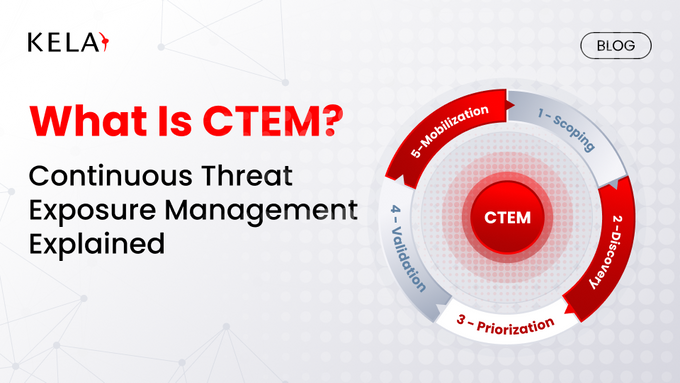
The Five Stages of the CTEM Cycle
To successfully implement a CTEM program, organizations must move through a continuous loop that ensures security efforts are always relevant to the current threat landscape.
- Scoping: Organizations establish the boundaries of the CTEM program by identifying the systems, assets, and environments that are most critical to business operations and risk exposure. This ensures that security efforts remain aligned with organizational priorities and the areas of greatest potential impact.
- Discovery: The discovery phase focuses on achieving broad visibility across the attack surface. This includes identifying vulnerabilities, configuration weaknesses, identity-related risks, and other potential exposure points across on-premises, cloud, and hybrid environments.
- Prioritization: Exposures are evaluated through a risk-based and threat-informed approach to determine which issues present the greatest likelihood and potential business impact. This allows organizations to focus resources on the exposures that pose the most significant operational and security risks.
- Validation: Validation confirms whether identified exposures can realistically be exploited within the environment. Through security testing, simulation, or controlled adversarial techniques, organizations gain a clearer understanding of the practical impact and exploitability of specific risks.
- Mobilization: The final phase centers on coordinated remediation and response. Security, IT, and operational stakeholders work together to address validated exposures efficiently, using contextualized insights to support informed decision-making and timely risk reduction.
» Understand why you need a threat intelligence platform
The Evolution: Traditional Vulnerability Management (VM) vs. CTEM
Traditional VM often operates in a vacuum, focusing on technical severity (CVSS) without business context. CTEM integrates threat intelligence and business criticality to prioritize mobilization.
Feature | Traditional Vulnerability Management | CTEM |
|---|---|---|
Operational Philosophy | Reactive & technical: Focused on identifying software flaws (CVEs) | Proactive & strategic: Focused on identifying and managing total business exposure. |
Scope of Visibility | Asset-centric: Limited to known devices and internal software. | Omni-channel: Includes SaaS, Cloud, Identity, Shadow IT, and external attack surfaces. |
Prioritization Logic | Severity-based: Relies on technical scores (CVSS) without business context. | Risk-centric: Correlates business criticality with real-world threat intelligence. |
Workflow Cadence | Periodic: Driven by scheduled scans (weekly, monthly, or quarterly). | Continuous: A persistent, five-stage cycle that adapts to environment changes in real time. |
» Make sure you know the difference between a vulnerability, a threat, and a risk

Cyber Threat Intelligence
KELA helps you prioritize validated threats so you can focus on lowering cyber risks and preventing breaches.
Why CTEM is the New Standard
Traditional approaches focus on identifying and remediating large volumes of vulnerabilities without consistent business prioritization. This often leads to effort being spread across issues with uneven impact on the business.
CTEM shifts the focus to value. It prioritizes exposures that have real business impact and deprioritizes low-relevance findings. The result is a more focused and risk-driven security approach.
1. Risk Management
Security operations are consistently hampered by the sheer volume of vulnerability data. With industry benchmarks showing that organizations typically remediate only 10% of identified vulnerabilities monthly, CTEM provides a critical filtering mechanism. By focusing on business-aligned risk, the framework ensures that internal resources are not expended on the 90% of technical debt that poses no immediate threat to the enterprise
2. Eliminating the "Visibility Gap"
Modern distributed environments often result in critical visibility gaps. CTEM replaces static inventories with dynamic, continuous monitoring. This framework uncovers unauthorized cloud deployments and unmanaged identities in real time, allowing security teams to secure exposures before they are discovered by external threat actors
3. Bridging the "Reality Gap"
A vulnerability might be labeled "Critical" by a technical scanner, but if that system is isolated and holds no sensitive data, it isn't a strategic priority. CTEM provides actionable insights by adding business context. This allows leadership to align security efforts with the "crown jewels" of the organization, moving from technical lists to business-aligned goals.
4. Cost Efficiency
With the average time to identify and contain a breach sitting at 241 days, the financial and reputational stakes are high. CTEM compresses this window by simulating attack paths and validating exposures. Finding and closing a door during an attacker’s reconnaissance phase rather than after data exfiltration- dramatically reduces the potential cost of a breach.
» Make sure you understand how threat actors breach and exploit your data
The limitations: What to expect
CTEM is a valuable framework for improving continuous exposure management, but it should not be viewed as a standalone solution. Recognizing its limitations is essential for establishing realistic expectations at the executive level.
- Operational resilience remains essential. CTEM strengthens exposure management and risk prioritization, but it does not eliminate the need for broader resilience measures. Organizations must still maintain mature incident response, backup, and disaster recovery capabilities to prepare for emerging threats, including previously unknown vulnerabilities and attack techniques.
- Data quality directly impacts effectiveness. The success of a CTEM program depends heavily on the accuracy and completeness of the data supporting it. Incomplete asset visibility, outdated threat intelligence, or inconsistent telemetry can weaken prioritization efforts and reduce the overall effectiveness of the framework. Maintaining accurate, continuously updated visibility across the environment is therefore critical.
- CTEM is not solely a technical initiative. Its effectiveness depends on strong collaboration across security, IT, and operational functions. Organizations that lack alignment, shared accountability, or established communication processes may struggle to sustain the coordination required for successful mobilization and long-term execution.
- CTEM is most effective in organizations that already maintain a baseline level of cybersecurity maturity. Core practices such as asset visibility, vulnerability management, and patch governance must be established before a continuous exposure management program can deliver meaningful results. The framework is designed to support organizations transitioning from reactive security operations toward a more proactive and risk-focused approach.
» Find out which threats and vulnerabilities can lead to data breaches
Operationalization, Measurement, and Business Impact of CTEM
Implementing CTEM reflects a broader shift in organizational maturity. It requires alignment across security, IT, and operational functions, supported by shared ownership of risk.
Success depends on moving away from siloed security operations toward a coordinated governance model where exposure management is continuously prioritized and acted upon across the organization.
- Asset visibility as a foundation: You cannot manage what you cannot see. A robust CTEM program requires a live inventory of internal and external assets, including third-party SaaS and cloud footprints.
- Data integrity: The framework is only as effective as the telemetry powering it. High-fidelity threat intelligence is required to ensure that prioritization is based on real-world adversary behavior.
- Cross-functional governance: CTEM is not a "security-only" initiative. It requires an agreement between Security (identification), IT (remediation), and Business Leaders (risk tolerance).
» Dive deeper with our guide to navigating third-party risks
Business Impact: Beyond the "Security Budget"
The ROI of CTEM is found in operational efficiency and risk avoidance. By focusing resources on validated exposures, organizations reduce "wasted effort" on low-risk vulnerabilities and significantly lower the probability of a high-impact breach.
For the CISO, CTEM provides the data necessary to report risk in business terms shifting the conversation from "how many patches we deployed" to "how much business exposure we have mitigated."
» Read more about protecting your organization from future cybercrime
The Future of CTEM
CTEM is not a static framework; it is evolving alongside the complexities of the modern threat landscape. As organizations move toward greater digital maturity, the role of exposure management will shift from a reactive security function to a predictive business enabler.
The Shift to Predictive Exposure Management
The integration of Artificial Intelligence (AI) and Machine Learning (ML) is transforming the "Prioritization" and "Validation" stages. Future CTEM workflows will move beyond identifying existing gaps to predicting potential attack paths before they are weaponized. AI-powered analytics will allow CISOs to simulate thousands of adversary scenarios in seconds, providing a proactive defense that stays ahead of automated threat actors.
Convergence with Zero Trust Architecture
CTEM and Zero Trust are increasingly becoming two sides of the same coin. While Zero Trust focuses on "never trust, always verify" at the point of access, CTEM provides the continuous visibility needed to ensure those access points—and the identities behind them are not exposed. This integration creates a more adaptive security posture where access levels can be adjusted in real-time based on the organization's current exposure score.
Automated Mobilization and "Self-Healing" Infrastructure
The "Mobilization" stage is moving toward Hyper-Automation. In more mature environments, the identification of a validated attack path will trigger automated playbooks that can temporarily isolate a vulnerable asset or adjust firewall configurations without human intervention. This reduces the "speed gap" and ensures that critical exposures are mitigated in minutes, not months.
Board-Level Risk Quantization
As the framework matures, the reporting of security data will undergo a paradigm shift. The future of CTEM lies in its ability to translate technical telemetry into financial and operational risk metrics. Instead of discussing "vulnerabilities," CISOs will be able to present the "Probability of Business Interruption" to the board, making security a core component of the enterprise's broader risk management strategy.
» Concerned about the future? See these other trends shaping the future of CTI or check out our future of cybercrime podcast
Stop Breaches Early
Discover how KELA turns threat intelligence into clear action so you can prevent the next data breach.
Operationalizing CTEM with KELA
Most organizations already possess the necessary telemetry, what is missing is the external context.
KELA bridges this gap by integrating real-world cybercrime intelligence into the CTEM workflow. By monitoring the dark web and cybercriminal forums, we identify which vulnerabilities are actively being traded or targeted by adversaries. When integrated into your CTEM framework, KELA transforms raw discovery data into actionable intelligence, allowing your team to mobilize against the threats that truly matter.
Most environments already have enough tools. What’s usually missing is clarity on what matters right now. CTEM helps with that, but only if it’s grounded in real context, not just internal data.
» Get started for free with KELA and strengthen your cybersecurity
FAQs
What is CTEM?
CTEM is a continuous approach to identifying, assessing, and prioritizing security exposures based on business risk rather than isolated vulnerabilities.
How is CTEM different from vulnerability management?
Vulnerability management focuses on finding and patching known issues, usually ranked by severity score. CTEM goes further by validating which of those issues are actually exploitable in your environment and tied to assets that matter.
Does CTEM replace existing security processes?
No. CTEM complements existing security functions. It improves prioritization but still depends on incident response, monitoring, and recovery capabilities.
What is needed before implementing CTEM?
A basic level of security maturity is required, including asset visibility, vulnerability management, and consistent patching processes.