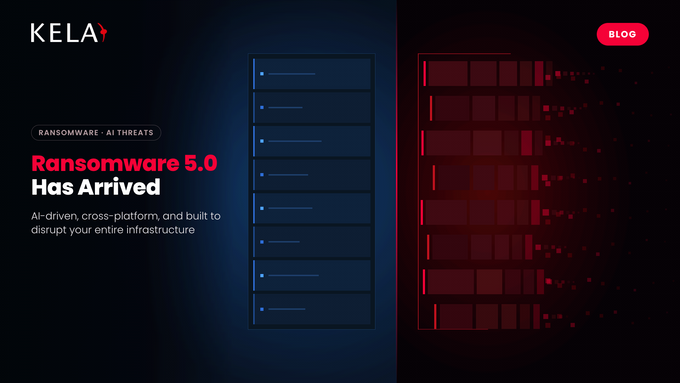
Ransomware 5.0 Explained: A CISO Guide for 2026 and beyond
This guide provides an analysis of how AI-powered automation and hypervisor-targeted attacks are reshaping the threat landscape. It equips security leadership with actionable frameworks for implementing control-plane segmentation and proactive intelligence to defend against cross-platform extortion syndicates.



Published September 2, 2026
According to the IBM Cost of a Data Breach Report, organizations hit by ransomware and extortion attacks faced average incident costs of $5.08 million, while 16% of breaches studied involved attackers using AI-powered tactics such as phishing and deepfake impersonation. Cybercriminal operations have evolved into highly organized, AI-assisted networks capable of scaling attacks faster, bypassing traditional defenses, and causing widespread operational disruption.
Organizations no longer face solitary hackers but rather highly efficient, AI-augmented syndicates that prioritize speed and infrastructure-wide disruption. In this blog, we’ll explore the architectural shifts of Ransomware 5.0, the adversary landscape, and the strategic defense measures required to survive this new era.
» Protect your business from ransomware today: Try KELA for free
What is Ransomware 5.0?
Modern threat actors achieve maximum operational disruption by integrating credential theft and supply-chain compromises with advanced evasion tactics. By utilizing deepfake-enabled phishing and "living-off-the-land" techniques, these groups bypass traditional security perimeters and remain undetected within a network for longer periods.
While earlier iterations of malware focused primarily on file encryption, the Ransomware 5.0 paradigm utilizes a quadruple extortion model to ensure payment. This strategy involves:
- Data theft: Exfiltrating sensitive corporate intelligence before encryption.
- Public leaks: Threatening to release proprietary data on "shame sites."
- DDoS attacks: Overwhelming the victim’s infrastructure to prevent recovery efforts.
- Direct harassment: Applying pressure directly to an organization's customers, partners, and stakeholders.
Recent data highlights the scale of this evolution, with industry reports indicating a 58% year-over-year surge in ransomware activity in 2026. Furthermore, AI-assisted tooling has reached a tipping point, with nearly 90% of all intrusion phases now benefiting from partial automation, allowing attackers to strike at a speed and scale previously impossible for human-led teams.
» Learn more about how ransomware operators gain access
Primary Targets of Ransomware 5.0
- Financial services: Attackers target high-frequency trading platforms and banking cores where even minutes of downtime result in millions in lost revenue and systemic market instability.
- Healthcare systems: Hospitals and medical providers are prioritized due to their near-zero tolerance for downtime, as encrypted patient records and locked diagnostic equipment directly threaten human lives.
- Manufacturing and industrial: Groups focus on Just-In-Time (JIT) production lines and smart factories where stopping a single assembly process can cause cascading supply chain failures.
- Energy and utilities: Critical infrastructure remains a top-tier target because the high public and political pressure to restore essential services often drives victims toward rapid ransom settlements.
» Worried you might be in danger? Here's how to know if you are an ideal ransomware victim
The Role of Artificial Intelligence
Artificial intelligence accelerates the ransomware lifecycle by automating reconnaissance, phishing, credential theft, lateral movement, and evasion techniques. Modern ransomware groups use generative AI to create highly convincing phishing emails, deepfakes, and adaptive malware capable of changing behavior in real time. Recent industry reports indicate AI is involved in 83% of cyberattacks, while some threat actors automate up to 80–90% of intrusion workflows. Attack breakout times have fallen below 30 minutes in several incidents.
To counter this, defensive automation must evolve toward AI-driven detection and autonomous response. Modern SOCs increasingly rely on XDR, SOAR, behavioral analytics, and AI-assisted threat hunting to correlate endpoint, identity, cloud, and network telemetry in real time. Automated containment, deception technologies, and predictive analytics are becoming essential to stop ransomware before encryption and exfiltration occur.
» Did you know? Ransomware groups are now selling network access directly
The Shift to Cross-Platform and Hypervisor Targeting
The move away from purely opportunistic Windows-based attacks toward hypervisor-targeted campaigns has redefined the organizational attack surface. This evolution forces security teams to defend deep infrastructure layers previously considered secondary targets.
- Virtualization layer compromise: Ransomware targeting VMware ESXi environments can encrypt dozens or even hundreds of virtual machines simultaneously, significantly increasing operational disruption. Attackers increasingly focus on hypervisors and exposed management interfaces because they provide access to large portions of enterprise infrastructure through a single entry point.
- Expanded Linux server exposure: Linux environments have become a growing target for ransomware operators as organizations continue shifting critical workloads to cloud-native and containerized infrastructure. Modern ransomware groups increasingly develop Linux-compatible malware capable of disrupting virtual machines, databases, containers, and enterprise cloud services alongside traditional Windows systems.
- Cloud and hybrid infrastructure risk: Modern ransomware increasingly targets Kubernetes, NAS devices, and hybrid-cloud orchestration layers. Analysts observed a 62% rise in attacks against cloud-connected infrastructure, expanding the attack surface beyond traditional on-premise networks.
- Credential and identity centralization: Cross-platform attacks increasingly exploit centralized identity systems such as Active Directory and federated authentication. Studies show over 80% of ransomware intrusions now involve credential abuse, enabling attackers to pivot seamlessly between Windows, Linux, and virtualized
» Learn more: The ransomware path from start to end
The Adversary Landscape
Five key threat actors are currently driving the architectural evolution of the 2026 landscape.
1. LockBit 5.0
LockBit has evolved into a highly modular RaaS platform targeting Windows, Linux, and VMware ESXi simultaneously. Its payloads include dedicated cross-platform binaries capable of hypervisor-level encryption, enabling mass VM disruption. Technical capabilities include AES/ChaCha-based encryption, LSASS credential dumping, and Group Policy propagation. The ESXi variant can forcibly shut down virtual machines before encrypting datastores.
2. Akira
Akira is a fast-moving RaaS group focused on VPN-based intrusion and credential abuse for rapid lateral expansion. Its payloads operate across Windows and Linux environments, using Rust-compiled encryptors optimized for speed. Akira emphasizes double extortion through pre-encryption data theft and staged exfiltration pipelines.
3. BlackLock
BlackLock is a Go-language-based cross-platform ransomware designed for unified deployment across Windows, Linux, and VMware ESXi systems. Its single-binary architecture enables consistent execution logic across environments. It uses built-in cryptographic libraries for fast file encryption and integrates modular components for network propagation.
4. Black Basta
Black Basta is a double-extortion group known for sophisticated enterprise intrusion chains. Its payloads support Windows and Linux and are frequently deployed after initial access via phishing or compromised VPN credentials. It uses ChaCha20 and RSA hybrid encryption schemes and often disables recovery mechanisms such as shadow copies.
5. Cl0p
Cl0p operates as a high-scale extortion-focused actor shifting toward zero-day exploitation and file-transfer supply chain attacks. Its strategy emphasizes pre-encryption data theft. Cl0p’s operations now span hybrid environments through compromised enterprise applications and cloud-connected systems, using stealthy staging servers to maximize theft.
Fortifying the Enterprise: Strategic Prevention and Detection
To counter the velocity of modern attacks, organizations must move beyond traditional perimeter security toward a model that prioritizes internal containment and proactive visibility.
Strict Control-Plane Segmentation
Organizations must isolate hypervisor management interfaces, backup networks, and orchestration platforms from production workloads through dedicated VLANs and MFA-protected bastion hosts. Industry guidance highlights that exposed management services serve as a primary entry vector for infrastructure-wide compromise.
Robust segmentation limits the paths available for lateral movement and significantly restricts the blast radius during a security incident.
Identity Hardening
Because the majority of intrusions rely on compromised credentials, security teams must deploy phishing-resistant MFA and Privileged Access Management (PAM) solutions. Hypervisor administrators should utilize separate, hardened accounts that remain isolated from standard directory synchronization.
Integrating behavioral analytics allows for the identification of abnormal authentication patterns, stopping attackers before they can achieve full domain control.
Behavioral Telemetry Correlation
A modern SOC should deploy cross-domain behavioral telemetry correlation to unify endpoint, identity, and network data into a single view. Rather than managing isolated alerts, this approach builds sequences of behavior to identify precursors like credential dumping or mass file enumeration.
This visibility enables the detection of staging activities before the encryption sequence begins, allowing for much earlier intervention across hybrid environments.
» Learn more about how hackers gain entry to your systems

Afraid of Ransomware?
Don't let the threat of ransomware attacks slow your business down. KELA Cyber can secure your systems against this evolving attack.
How KELA Cyber Can Help
Stopping Ransomware 5.0 means seeing the attack before it reaches your perimeter. Proactive cyber threat intelligence platforms such as KELA Cyber can be used to continuously monitor dark web forums, leak sites, and initial access broker (IAB) marketplaces to detect stolen credentials and compromised access before they are operationalized.
By aggregating data from onion sites, Telegram channels, and criminal marketplaces, KELA Cyber identifies mentions of corporate domains or leaked VPN access. Security teams can then preemptively reset credentials and revoke sessions, reducing dwell time from weeks to hours. This shifts defense from reactive incident response to proactive disruption of attacker supply chains, significantly improving the enterprise risk reduction posture against Ransomware 5.0.
» Ready to begin? Set a FREE session with our experts
FAQs
What specifically distinguishes Ransomware 5.0 from previous generations?
Ransomware 5.0 is defined by its modular, cross-platform architecture and its ability to target the virtualization layer directly. Unlike earlier versions that focused on Windows endpoints, 5.0 variants utilize AI to automate intrusions and encrypt Linux and VMware ESXi hypervisors at scale.
Why is "Quadruple Extortion" becoming the standard model?
Attackers now use four layers of pressure to ensure payment: file encryption, sensitive data exfiltration (double), DDoS attacks to hinder recovery (triple), and direct harassment of an organization's customers or stakeholders (quadruple).
This approach bypasses the protection offered by traditional backups.
How does AI-assisted tooling affect the "breakout time" of an attack?
AI automates reconnaissance and lateral movement, reducing the "breakout time"—the interval between initial access and full network compromise to under 30 minutes.
This high-velocity execution often completes the attack before human-led security teams can effectively intervene.
Is traditional multi-factor authentication (MFA) enough to stop 5.0 actors?
Standard MFA is no longer sufficient as 5.0 actors frequently bypass it through session token theft or MFA fatigue attacks.
Organizations must transition to phishing-resistant hardware keys and behavioral analytics to identify when valid credentials are being used for malicious activity.
What is Ransomware 5.0?
Ransomware 5.0 is the 2026 evolution of ransomware, defined by AI-powered automation, modular ransomware-as-a-service (RaaS) architectures, and the ability to attack Windows, Linux, cloud, and virtualized infrastructure like VMware ESXi at the same time. It combines credential theft, supply-chain compromise, and evasion to cause infrastructure-wide disruption rather than just encrypting files.
What is quadruple Ransomware extortion?
Quadruple extortion is a pressure model where attackers go beyond encryption. They steal data before encrypting it, threaten to leak it on public "shame sites," launch DDoS attacks to block recovery, and directly harass an organization's customers, partners, and stakeholders to force payment.
Why are ransomware groups targeting VMware ESXi and hypervisors?
Hypervisors give attackers access to large portions of enterprise infrastructure through a single entry point. Ransomware that compromises an ESXi environment can encrypt dozens or hundreds of virtual machines simultaneously, which massively increases operational disruption from one attack.
How is AI used in modern ransomware attacks?
Attackers use AI to automate reconnaissance, generate convincing phishing emails and deepfakes, steal credentials, move laterally, and create adaptive malware that changes behavior in real time. This automation has pushed attack breakout times below 30 minutes in some incidents.
Which industries are most targeted by Ransomware 5.0?
Financial services, healthcare, manufacturing, and energy and utilities are primary targets. These sectors share a low tolerance for downtime, which raises the pressure to pay quickly when systems, patient records, production lines, or critical infrastructure are locked.
How can organizations defend against Ransomware 5.0?
Core defenses include strict control-plane segmentation to isolate hypervisor and backup systems, identity hardening with phishing-resistant MFA and privileged access management, and behavioral telemetry correlation across endpoint, identity, and network data to catch attacks before encryption begins.
How does cyber threat intelligence help against ransomware?
Cyber threat intelligence monitors dark web forums, leak sites, and initial access broker marketplaces for stolen credentials and compromised access tied to your organization. Surfacing that exposure early lets security teams reset credentials and revoke sessions before attackers can use them, shifting defense from reactive response to proactive disruption.