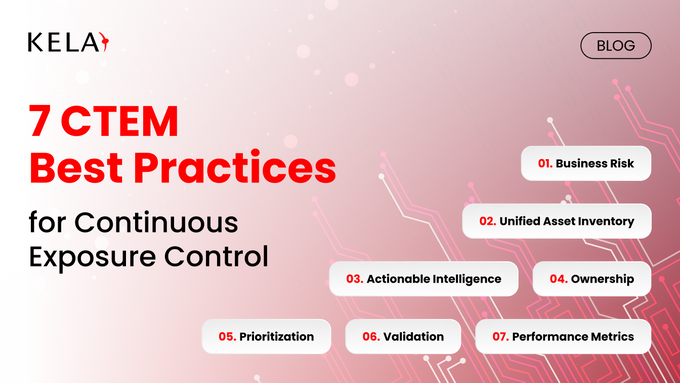
7 CTEM Best Practices for Continuous Exposure Control
CTEM is no longer a theoretical framework, it is how modern organizations manage exposure across fast-changing cloud, SaaS, and hybrid environments. This blog breaks down the best practices that reduce risk in practice.


Published June 24, 2026
You can have all the tools in place, run scans constantly, and still feel like nothing is actually getting safer. That's the reality for many teams trying to manage exposure in fast-moving environments. The issue is not visibility alone, it is knowing what matters and acting on it before it becomes a problem.
As environments expand across cloud, SaaS, and third parties, keeping track of real risk becomes harder. More data doesn't always mean better decisions, especially when teams are already stretched. What makes the difference is how exposure is prioritized, validated, and reduced over time.
In this blog, we'll break down how CTEM works, where it fails, and what you need to focus on to reduce exposure.
» Strengthen your cybersecurity with KELA's expertise
Operational Challenges, Pressure Points, and Early Warning Signs
In real environments, CTEM doesn't break because of a lack of tools. It breaks in the day-to-day execution, where change, pressure, and limited resources all collide.
Common challenges you will run into:
- Constantly changing environments: In cloud and hybrid setups, assets are created and removed all the time. New services often go live without being added to scanning scope, which leaves exposure gaps that no one sees early on.
- Too many alerts with little context: Teams deal with a high volume of alerts but struggle to understand what actually matters. Without clear prioritization, response slows down and important issues get buried.
- Disconnected tooling: Asset discovery, vulnerability data, and threat intelligence often sit in separate tools. Without integration, teams cannot see the full picture or track real exposure properly.
- Unclear ownership across teams: Security identifies issues, but engineering or IT needs to fix them. When ownership is not clearly defined, remediation gets delayed or ignored.
- Limited resources for remediation: There are often not enough people to fix what is found. This leads to growing backlogs and unresolved exposure over time.
NIST highlights continuous monitoring as essential for managing evolving risk, yet many environments struggle to maintain it.
» Here's everything you need to know about cyber threat intelligence
Where CTEM Starts to Break Under Pressure
As these challenges build up, CTEM starts losing effectiveness. This usually happens gradually, not all at once.
- Backlogs grow faster than they are reduced: Vulnerabilities are identified continuously, but remediation can't keep up, which increases overall exposure.
- Fragmented workflows slow response: When tools and processes are not connected, teams lose context and waste time figuring out what to fix first.
- Silos delay action: Security, DevOps, and IT are not aligned, so even confirmed risks take longer to resolve.
» Make sure you know the difference between a vulnerability, a threat, and a risk
When CTEM Becomes Counterproductive
There is a point where CTEM stops reducing risk and starts creating noise. This happens when the focus shifts too far toward detection and not enough toward resolution.
Early warning signs to watch for:
- Remediation timelines keep increasing: If it takes longer and longer to fix vulnerabilities, the process is slowing down. This often happens when ownership is unclear or teams are overloaded, leaving critical issues open for extended periods.
- The same vulnerabilities keep reappearing: When scans repeatedly flag identical issues, it shows that fixes are either not implemented or not effective. This creates a cycle where exposure is tracked but not reduced.
- Vulnerability backlog continues to grow: If the number of open issues increases over time, the program is not keeping up. This usually points to poor prioritization or not enough resources to handle remediation.
- Alerts start getting ignored: When teams are overwhelmed with alerts, fatigue sets in. Over time, everything starts to look the same, and critical issues can be missed because they do not stand out anymore.
IBM shows that longer remediation cycles lead to significantly higher breach costs.
» Read more: Here are the top vulnerabilities discussed on cybercrime sources

Act On Real Threats Faster
Act faster on real threats with KELA and reduce exposure before attackers can take advantage.
7 CTEM Best Practices That Work
If CTEM is going to deliver real results, it has to work in the way your environment actually runs. These best practices focus on closing exposure gaps, improving how teams operate day to day, and making sure effort leads to real risk reduction.
1. Anchor CTEM In Business Risk, Not Security Metrics
This is the foundation of CTEM. If everything is not tied to business impact, prioritization becomes misaligned and reporting loses meaning. This best practice shifts the focus from technical volume to what actually affects the business.
Pain points this solves
- Security teams report vulnerability counts and patch levels, but leadership needs visibility into business risk and potential impact.
- High volumes of technical findings make it difficult to identify what truly matters to operations.
- Remediation effort is often spent on issues that look severe technically but have little real-world impact.
How it works operationally
In daily workflows, every CTEM phase is driven by business context. Assets are classified based on how critical they are before any triage happens. SOC analysts do not just see alerts, they see which systems are tied to revenue, operations, or sensitive data.
Reporting also shifts from raw numbers to exposure trends linked to critical assets, which changes how decisions are made across both technical and leadership levels.
What improves when done properly
When prioritization is aligned to business impact, remediation backlogs become more manageable because teams stop focusing on low-value issues. Response becomes faster because effort is directed where it matters most. Organizations also gain clearer visibility into whether critical assets are exposed or protected, which makes reporting easier to act on.
How to implement it
- Identify your most critical systems, processes, or data sets and define what would cause the most disruption if compromised.
- Assign business impact levels to these assets so they can be used consistently during prioritization.
- Build this context into your CTEM workflows so every finding is evaluated against business impact before action is taken.
2. Build A Continuously Updated, Unified Asset Inventory
This is what everything else depends on. If your asset view is incomplete or outdated, every CTEM decision that follows is unreliable.
Pain points this solves
- Assets are constantly created and removed in cloud and hybrid environments, making it easy to lose track of what exists.
- Shadow IT and third-party integrations introduce systems that are never formally tracked.
- Exposure metrics become inaccurate because they are based on incomplete visibility.
» Here's everything you need to know about third-party risk management
How it works operationally
The asset inventory feeds directly into every CTEM phase. It defines what gets discovered, provides ownership and context during prioritization, and ensures remediation is routed correctly. This requires pulling data from multiple sources and continuously updating it so it reflects the real environment at any given time.
What improves when done properly
Organizations quickly see an increase in asset coverage, often within the first few months. More importantly, unknown assets stop appearing during incidents, which reduces response time and prevents avoidable exposure. The overall quality of prioritization also improves because decisions are based on complete data.
How to implement it
- Automate asset discovery using real-time triggers such as cloud provisioning events, identity changes, and network updates.
- Continuously update the inventory so it reflects the current state of the environment rather than relying on periodic scans.
- Enrich asset data with ownership and business context so it can be used across CTEM workflows.
3. Prioritize By Exploitability And Business Impact Not CVSS Alone
Not every vulnerability deserves the same level of attention. This best practice ensures effort is focused on exposures that can actually be used in real attacks.
Pain points this solves
- CVSS scores often drive prioritization even when vulnerabilities are not exploitable in the environment.
- Teams spend time fixing theoretical risks while real attack paths remain open.
- Large volumes of vulnerabilities make it difficult to focus remediation effectively.
How it works operationally
Prioritization combines asset criticality, exploitability data, and threat intelligence. Instead of relying on scanner output alone, findings are ranked based on whether they can be used in an actual attack and what impact they would have. This gives teams a focused remediation queue that reflects real risk.
What improves when done properly
Remediation becomes more targeted, which reduces backlog growth and improves response times. Teams spend less time on low-impact issues and more time reducing actual exposure. Over time, this leads to measurable reduction in attack surface rather than just higher patch counts.
How to implement it
- Combine CVSS scores with asset criticality and exploitability indicators such as EPSS or threat intelligence.
- Use this combined view to rank findings before they enter the remediation queue.
- Keep the prioritization model simple so teams can act quickly without delays.
4. Embed Continuous Validation Into Security Operations
Validation is what confirms whether an exposure is actually a risk. Without it, teams rely too heavily on assumptions.
Pain points this solves
- Periodic testing leaves long gaps where exposures go untested.
- Vulnerabilities are assumed to be protected without real validation.
- Security controls are not consistently tested under real conditions.
How it works operationally
Validation is triggered by events such as new exposures, configuration changes, or updated threat intelligence. It runs continuously in the background and feeds results directly into remediation and detection workflows. This creates a feedback loop that improves both prevention and response.
What improves when done properly
Detection improves because validation exposes gaps in controls. Teams confirm exploitable paths faster, which reduces the time exposures remain active. This leads to faster response and more accurate prioritization.
How to implement it
- Start with high-priority assets so validation efforts stay focused and manageable.
- Define trigger events such as new internet-facing assets or critical configuration changes.
- Ensure validation results are automatically fed into remediation workflows so they lead to action.
» Understand why you need cyber threat intelligence for your organization
5. Operationalize Mobilization With Clear Ownership And Workflows
This is where exposure gets reduced or ignored. Without proper mobilization, CTEM doesn't deliver results.
Pain points this solves
- Findings are identified but not fixed due to unclear ownership.
- Remediation is delayed because workflows are not defined.
- Teams spend time figuring out responsibility instead of resolving issues.
How it works operationally
Findings are automatically routed into ITSM systems with predefined ownership, SLAs, and escalation paths. Each issue is assigned to the correct team based on asset and exposure type, and progress is tracked until remediation is verified.
What improves when done properly
Exposure windows are reduced because issues are addressed faster. Teams work more efficiently because ownership and expectations are clear. This also improves audit readiness through consistent tracking and documentation.
How to implement it
- Define ownership for each type of exposure before findings start flowing.
- Set SLA timelines based on risk and business impact.
- Establish escalation paths so delays are addressed quickly.
6. Integrate Threat Intelligence Into Prioritization
This is what turns CTEM from reactive to proactive. It ensures teams focus on what attackers are actually using.
Pain points this solves
- Teams do not know which vulnerabilities are actively being targeted.
- Prioritization is based only on internal data without external context.
- Decision-making slows down due to uncertainty about real threats.
How it works operationally
Each exposure is checked against threat intelligence and adversary behavior before prioritization. This ensures that remediation focuses on vulnerabilities that are actively relevant to the organization’s threat landscape.
What improves when done properly
Teams focus on a smaller, more relevant set of exposures. This improves remediation speed and ensures effort is aligned with real threats. It also provides a clearer way to measure attack surface reduction over time.
How to implement it
- Integrate threat intelligence directly into your prioritization workflow.
- Automate correlation so new threats are immediately checked against your environment.
» Get notified about threats targeting your organization in real-time. Try KELA’s Cyber Threat Intelligence Platform for Free.
7. Define And Track CTEM Performance Metrics Tied To Outcomes
This is what shows whether CTEM is actually working. Without it, improvement is difficult to prove.
Pain points this solves
- Teams track activity instead of actual exposure reduction.
- Leadership does not have visibility into program effectiveness.
- It is difficult to identify where CTEM processes are breaking down.
How it works operationally
Metrics are collected across each CTEM cycle and used to guide improvements. These include remediation timelines, exposure reduction, and validated attack paths. Reporting connects these metrics directly to business impact and helps guide decision-making.
What improves when done properly
Over time, organizations see faster remediation, fewer critical exposures, and clearer visibility into risk trends. Metrics also make it easier to justify investment and demonstrate progress across cycles.
How to implement it
- Start with a small set of metrics such as remediation time and reduction in critical exposures.
- Establish baselines before setting targets so progress can be measured accurately.
- Ensure metrics are tied to outcomes rather than activity so they reflect real impact.
» Understand how threat actors breach and exploit your data
CTEM KPIs That Show If You Are Reducing Exposure
If you're not tracking the right metrics, CTEM quickly turns into activity without proof of impact. These KPIs focus on whether exposure is actually going down, how fast teams respond, and where gaps still exist.
Mean Time To Remediate (MTTR)
This tells you how long it takes to go from identifying an exposure to fully resolving it. It is one of the clearest indicators of whether your CTEM program is working in practice.
The benchmark for critical vulnerabilities is under 21 days, with stronger environments pushing closer to 14 days. IBM data shows it takes an average of 277 days to identify and contain a breach, which makes MTTR critical in reducing that window. If MTTR is not improving, exposure is staying open longer than it should.
Attack Surface Coverage Rate
This measures how much of your environment is actually being monitored. If assets are not covered, they are not protected.
The target for tier-one or critical assets should be at least 95% coverage across cloud, on-prem, SaaS, and third-party systems. Organizations using CTEM typically achieve higher visibility compared to traditional approaches. Any gap in coverage means there are assets your team cannot see, but attackers eventually will.
Remediation SLA Compliance Rate
This shows whether validated exposures are being fixed within agreed timeframes. It reflects how well teams are executing, not just identifying issues.
Best practice sets critical remediation within 24 to 48 hours and high severity within 7 days. Many organizations still struggle to consistently meet these targets, especially as environments grow and ownership becomes less clear. When remediation slows down, exposure begins to accumulate, often without being immediately visible across systems.
Rate Of Vulnerability Recurrence
This tracks how often the same vulnerability comes back after being fixed. It highlights whether remediation is actually solving the problem.
A healthy threshold is below 5%. When recurrence increases, it usually means fixes were incomplete, root causes were not addressed, or deployment pipelines are reintroducing the issue. This metric exposes weaknesses in processes that simple closure rates will not show.
Validated Attack Paths To Crown-Jewel Assets
This measures how many real, exploitable paths exist to your most critical systems. It focuses on actual risk rather than volume of findings.
The goal is to reduce this number consistently over time, ideally moving toward zero. While CTEM adoption is growing at over 10% annually, many organizations still don't track this metric properly. Without it, it is difficult to prove whether exposure is being reduced.
Mean Time To Detect (MTTD)
This measures how quickly exposures are identified after they appear. It defines how long risk exists before your team is even aware of it.
For mature CTEM programs, the benchmark is under 24 hours for critical assets. When detection times are longer, it usually points to visibility gaps or weak correlation between tools and intelligence. Together, MTTD and MTTR define your full exposure window from discovery to resolution.
» Stay up to date with the key cyber threats coming in 2026
Stay Ahead Of Active Threat Actors
KELA tracks attacker tactics so you can anticipate risk and act before damage is done.
How KELA Cyber Helps You Stay Ahead Of Threats
At KELA Cyber, our focus is on helping you understand which threats matter to your environment and what needs attention before they escalate. Instead of dealing with endless alerts, you get intelligence that is filtered, relevant, and tied to real risk so your team can focus on decisions that matter.
Our Cybercrime Threat Intelligence platform brings together context that is often missing in day-to-day security work. It shows how threat actors operate, what tactics they use, and how those behaviors map back to your environment. You also get visibility across ransomware, vulnerabilities, insider threats, and supply chain risks in one place, which helps you see exposure as a whole rather than in isolation.
» Ready to begin? Contact us to learn more or try KELA for free
FAQs
What is CTEM in cybersecurity?
Continuous Threat Exposure Management is a structured approach that continuously identifies, prioritizes, validates, and reduces exposure across an organization’s attack surface. It focuses on real risk rather than one-time assessments, helping teams manage vulnerabilities in an ongoing way as environments change.
How is CTEM different from traditional vulnerability management?
Traditional vulnerability management is usually periodic and focused on scanning and patching.
CTEM goes further by adding prioritization based on business impact, continuous validation of exposures, and tracking whether remediation actually reduces risk over time. It shifts focus from volume of findings to real exposure reduction.
How do you measure if a CTEM program is working?
Effectiveness is measured through KPIs like Mean Time to Remediate, attack surface coverage rate, SLA compliance, vulnerability recurrence rate, and reduction in validated attack paths to critical assets. If these metrics are improving over time, exposure is being reduced.
What causes CTEM programs to fail?
CTEM usually fails when it becomes a visibility exercise instead of an action-driven process. Common reasons include lack of ownership, poor integration between tools, focusing on too many low-impact issues, and not aligning priorities with business risk. Without execution, CTEM turns into tracking rather than reduction.