How to Choose the Best Attack Surface Visibility Platform
Understanding how to identify blind spots and prioritize risks is essential. This guide explains key factors for choosing platform for attack surface visibility, helping you maintain clear oversight, integrate tools effectively, and strengthen your security posture.

Published June 28, 2026
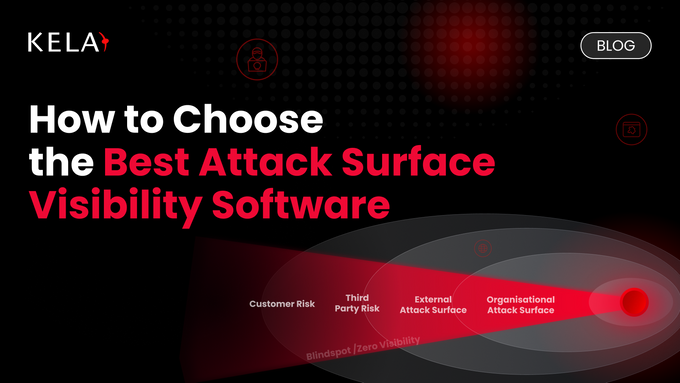
Organizations manage an expanding range of assets across cloud, on-premises, SaaS, IoT, and OT systems. Security teams must maintain clear visibility to identify risks, monitor exposures, and prioritize mitigation effectively. Blind spots in any layer can create significant operational and regulatory challenges.
Tools that provide actionable insights and integrate with existing workflows are essential for maintaining control and reducing potential threats. In this blog, we will explore key considerations for choosing a solution for attack surface visibility and how it can strengthen your business security strategy.
» Skip to the solution: Try KELA's cyber threat intelligence for free
Defining Attack Surface Boundaries
An organization should define its attack surface from an attacker’s perspective. This includes any digital asset that is discoverable and targetable from the internet, regardless of ownership or management.
The boundary represents all digital connection points that could provide access to the organization’s data or infrastructure.
» Learn the difference: Internal vs. external attack surface in cybersecurity
Achieving Balance Between Scope and Focus
- Broad discovery first: Security teams should begin with wide asset discovery to identify all possible exposed systems and services. This ensures that unknown or unmanaged assets are not immediately excluded.
- Risk-based prioritization: Discovered assets should be filtered and ranked based on business criticality. A server processing customer payments carries a higher risk than a public-facing marketing blog.
- Business context and continuity: Stakeholder needs and operational impact should guide prioritization decisions. Protecting systems essential to daily operations helps maintain business continuity.
- Intelligence-driven focus: Combining asset classification with real-time threat intelligence allows teams to focus on assets that pose the most immediate danger, reducing noise without creating blind spots.
- Ongoing reassessment and monitoring: Attack surface boundaries must be reassessed continuously. In modern IT environments where new assets are deployed daily, quarterly, or annual reviews quickly become outdated. Without continuous monitoring, organizations develop gaps that increase exposure. Ongoing discovery and validation ensure new assets are identified and secured before they can be exploited, aligning with modern risk management practices.
» Not convinced? Here are the reasons you need cyber threat intelligence
Risks of Underestimating the Attack Surface
Underestimating the attack surface represents a significant risk in cybersecurity.
The seriousness of this risk is reflected in regulatory action, such as CISA’s Binding Operational Directive (BOD) 23-01, which mandates continuous discovery of all network-connected assets across federal agencies to prevent hidden exposure and long-term compromise.
» Read more: Here are the top vulnerabilities discussed on cybercrime sources
Commonly Missed Blind Spots
- Shadow IT systems, including unsanctioned SaaS platforms and cloud services
- Third-party and vendor-connected infrastructure with indirect network access
- Forgotten or legacy systems are still reachable from the internet
- Cloud misconfigurations and temporary assets created during development or testing
- Personal devices used under BYOD policies that bypass traditional inventories
» Read more: A dive into third-party risks and the Aldo incident
5 Requirements for Choosing a Platform for Attack Surface Visibility
1. Continuous Discovery Across Assets
An effective attack surface visibility tool continuously discovers and monitors a wide range of resources. This includes cloud resources such as virtual machines, storage buckets, and APIs.
It also covers:
- On-premises systems: servers, databases, and Active Directory
- SaaS platforms: Office 365, Salesforce, and GitHub
- IoT devices: printers, cameras, and medical equipment
- OT assets: SCADA and ICS systems
- Ephemeral instances: containers, serverless functions, and test VMs
In regulated industries, visibility into overlooked IoT and OT assets is essential to maintain security and compliance.
» Make sure you understand the difference between attack vector and attack surface
2. Effective Discovery Methods
To maintain accuracy while reducing false positives, the platform should adopt multiple discovery approaches.
- Active scanning to identify exposed services and misconfigurations.
- Passive monitoring to observe traffic patterns without disruption.
- Agentless collection to cover cloud and SaaS environments.
- External intelligence gathering to find assets visible from an attacker’s perspective.
Correlating internal telemetry with external exposure data ensures comprehensive coverage and confidence in the findings.
» Make sure you understand how threat actors breach and exploit your data
3. Risk Prioritization
A robust platform prioritizes risks based on asset criticality, threat likelihood, and technical severity, rather than raw CVSS scores. This approach aligns with CISA’s Known Exploited Vulnerabilities (KEV) catalog, which highlights vulnerabilities actively used in real-world attacks, enabling organizations to focus on the most immediate threats.
Leveraging the MITRE ATT&CK® framework further refines prioritization by mapping findings to known adversary tactics and techniques. This helps teams evaluate threat likelihood in the context of their own environment.
4. Cloud and Hybrid Environment Capabilities
To operate effectively in dynamic cloud and hybrid environments, the solution must have two essential capabilities:
Real-Time, API-Driven Discovery
The tool must connect directly to cloud provider APIs, such as AWS, Azure, and GCP, providing continuous visibility into all created assets. A survey by the Cloud Native Computing Foundation (CNCF) shows that most organizations use container technologies, which are often short-lived.
» Discover why NIST and CTI are the perfect match for building a cyber resilient organization
Contextual Awareness
Identifying new assets is just the first step. The platform must also understand the relationships among assets to assess potential risks. Attackers view interconnected pathways rather than isolated systems. A strong tool maps how vulnerabilities could compromise other assets.
» Make sure you know the difference between a vulnerability, a threat, and a risk
5. Integration with SOC Workflows
To avoid operational silos, the solution must integrate deeply with existing security operations workflows through bidirectional API connections. It should follow NIST’s Security Automation and Continuous Monitoring (SACM) guidance.
This ensures interoperability. It provides continuous feedback. It enables faster response times.
- SIEM/SOAR: Alerts should include asset criticality, exploitability (KEV/EPSS), and attacker TTP mapping (MITRE ATT&CK). This enables SOAR playbooks to enrich, triage, and quarantine high-risk assets automatically.
- Ticketing systems: API connectors must create actionable tickets in Jira or ServiceNow, including business impact (e.g., “system linked to PCI cardholder data”) and remediation guidance. This ensures accountability and measurable SLA tracking, reducing backlog issues in large enterprises.
- Vulnerability management tools: Combining outside-in discovery (internet-exposed misconfigurations, shadow IT, SaaS misuse) with inside-out scanners (authenticated patch scans, configuration checks) provides a comprehensive, risk-based view of the environment.
» Read more: Vulnerability discovery vs. vulnerability management

KELA Cyber in Action
KELA can help you identify real threats, connect external intelligence to your attack surface, and prioritize what matters most.
Vendor Claims That Should Raise Red Flags
Organizations should be cautious of vendors making sweeping promises about attack surface visibility. No single tool can provide perfect, permanent coverage, as assets are constantly appearing and disappearing in dynamic IT environments.
- Claims of "complete" or "100% coverage": Any vendor asserting complete coverage should be questioned. The reality is that no tool can map a constantly changing attack surface with perfect accuracy. Be wary of marketing that oversimplifies this complex challenge.
- The "AI-powered" secret sauce: Many vendors use "AI-Powered" as a buzzword without substantive proof. Always ask how their AI or machine learning works. Specifically, what problems does it solve? How does it reduce false positives or prioritize alerts? Vague answers often indicate marketing hype rather than actual capability.
- Shallow vs. deep integrations: Integration claims vary widely. A shallow integration is a one-way data feed into SIEM or ticketing systems. A deep, bidirectional API integration enables rich context sharing and automated actions, making the entire security workflow smarter and more effective.
- Vague advice vs. actionable guidance: The platform must provide clear, actionable guidance. This includes identifying the asset, its owner, and the exact remediation steps. Tools should align with established industry standards such as the NIST Cybersecurity Framework to ensure reliability and consistency.
» Read more: How agentic AI is transforming cybersecurity
Choosing a Platform for Attack Surface Visibility: How KELA Cyber Can Help Your Business
Cloud assets, SaaS platforms, on-prem systems, IoT, and OT each introduce unique blind spots that are hard to cover with a single tool. At KELA Cyber, we complement traditional attack surface management solutions with intelligence from hard-to-reach sources like dark web forums, closed communities, and illicit marketplaces. This outside-in perspective helps you connect exposed credentials, stolen data, or chatter to your environment, enabling smarter prioritization of risks.
By integrating KELA’s curated feeds with your existing tools, your business gains focused, actionable insights while reducing analyst workload, making it an essential part of a layered visibility strategy. Choosing a platform for attack surface visibility has never been more effective when paired with KELA’s intelligence.
» Get started for free with KELA and strengthen your cybersecurity
FAQs
What is attack surface visibility, and why does my business need it?
Attack surface visibility is the ability to discover, monitor, and understand all digital assets that could be targeted by attackers.
Your business needs it to identify blind spots, prioritize risks, and reduce the likelihood of breaches across cloud, on-premises, SaaS, IoT, and OT systems.
How often should my organization reassess its attack surface?
Because IT environments are dynamic, attack surfaces should be reassessed continuously or at least quarterly. Continuous monitoring ensures new or temporary assets are detected and secured before exploitation.
What discovery methods are most effective for attack surface visibility?
Effective methods include active scanning, passive monitoring, agentless collection, and external intelligence gathering. A combination reduces false positives while ensuring comprehensive coverage of all assets.
What should I watch for when choosing a solution for attack surface visibility?
Be cautious of vendors claiming “complete coverage” or vague “AI-powered” solutions. Ensure the tool offers deep, bidirectional integrations, provides clear actionable guidance, and aligns with established industry standards like NIST.