GDPR Third-Party Risk Management: A Strategic Implementation Guide
A practical guide to managing third-party risk under the GDPR. Covers controller accountability, vendor tiering, due diligence, Data Processing Agreements, and continuous monitoring, with a real AEPD enforcement case and a five-stage TPRM lifecycle you can implement.




Updated September 3, 2026
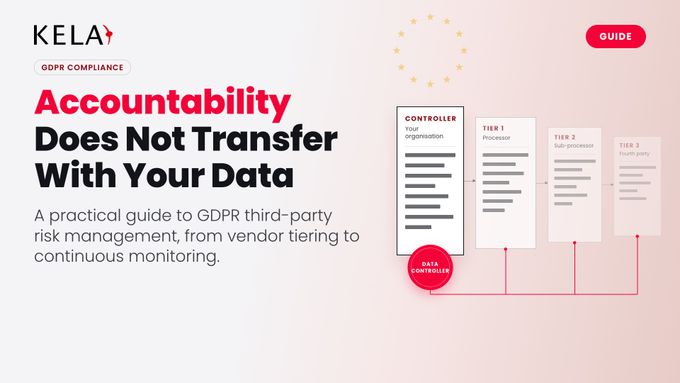
Every organization relies on third parties, whether it's cloud providers, payment processors, consultants, or software vendors. However, every external relationship that touches personal data introduces additional privacy and security risks. Under the GDPR, your organization remains accountable for how processors handle personal information, even when the data sits outside your direct control. Failing to manage these relationships properly can lead to regulatory penalties, financial losses, and reputational damage.
In this blog, we'll explore the fundamentals of GDPR third-party risk management, examine real-world lessons, and discuss practical strategies for building a more resilient vendor oversight program.
» Ensure your cybersecurity is up to standard with KELA
What Is GDPR Third-Party Risk Management?
GDPR third-party risk management is the process of embedding privacy accountability into these relationships to ensure that the entity processing data on your behalf adheres to the same legal and security standards as your internal team.
It requires a process-led framework centered on data subject rights, legal bases, and specific contractual commitments under Articles 24, 28, and 35.
Why Third-Party Risk Matters Under GDPR
Third-party relationships have become essential to modern business operations, but they also create additional exposure when personal data is shared beyond your organization's boundaries. Vendors often process significant volumes of sensitive information, and a single security failure can affect millions of individuals.
The GDPR places accountability firmly on the data controller, meaning your organization can still face regulatory scrutiny even if the breach originated with a service provider. As supply chains become increasingly interconnected, maintaining visibility over vendor practices becomes more challenging.
Effective third-party risk management helps you reduce legal, operational, and reputational exposure by ensuring that vendors apply appropriate privacy and security measures throughout the relationship lifecycle.
» Here's everything you need to know about third-party risk management
GDPR Foundations
GDPR accountability requires that you treat every vendor as a direct extension of your internal team. You remain legally responsible for how a processor handles your customer data, even when that processing occurs outside your immediate control.
- Establish a clear legal basis: Ensure every third-party vendor processes personal data strictly according to your documented instructions, typically formalized through a comprehensive Data Processing Agreement.
- Conduct privacy-centric due diligence: Evaluate a vendor’s specific technical and organizational measures to confirm they meet the standard of appropriate protection required by Article 32.
- Perform rigorous impact assessments: Complete a Data Protection Impact Assessment whenever a vendor’s processing activities, especially those involving new technologies, could create a high risk for the rights and freedoms of individuals.
- Maintain ongoing accountability: Treat vendor management as a continuous loop of supervision rather than a one-time onboarding exercise, ensuring your vendors maintain the same legal standards as your internal staff.
Lessons from a Failure: The Spanish Bank Case
Real-world failures highlight the dangers of treating vendor access with a "set it and forget it" mentality. A Spanish insurance and financial services provider was recently hit with a €4 million fine after a third-party broker’s credentials were compromised. Attackers used these credentials to gain unauthorized access to a customer management system, exposing the sensitive personal data, including IBANs and national identification numbers of approximately 1.5 million individuals.
Why it went wrong:
- Inadequate access controls: The organization failed to enforce strict, role-based access for the vendor, treating external credentials with the same level of trust as internal administrative accounts.
- Passive monitoring: The bank assumed that once access was granted, the security responsibility was "covered." They lacked the active behavioral monitoring needed to flag suspicious activities, such as bulk data extractions.
- Lack of data segregation: The architecture allowed the compromised broker account to reach far beyond the specific data points they required, effectively turning a single entry point into a full-scale database exposure.
Key Takeaways:
- Trust, but audit: Technical access must strictly follow the principle of least privilege. Even if a vendor requests broad access, deny it unless it is essential for their specific function.
- Monitoring never stops: Security is a living process. Utilize behavioral analytics to detect abnormal patterns or bulk pulls, regardless of whether the activity originates from an internal or external account.
- Accountability is non-delegable: Regulators hold the data controller accountable for third-party failures. A signed contract is merely the beginning; day-to-day operational enforcement is what keeps your data and your reputation secure.
The Tiers of Vendor Risk
Organizations should employ a risk-based scoring model to prioritize oversight, as not all vendors present the same threat to data subject rights.
- Tier 1: Critical vendors: These partners handle high-sensitivity data or are essential to core business operations. They require executive-level oversight, annual deep-dive audits, and constant monitoring of their security posture.
- Tier 2: Moderate vendors: These vendors manage smaller amounts of personal information or support non-core operations. Oversight typically involves periodic security questionnaires and assessment cycles every 18 months.
- Tier 3: Low-risk vendors: These entities have no access to personal data and low operational criticality. Management focuses on basic intake documentation and annual self-attestations to confirm their status has not changed.
» Stay in the loop for our upcoming GRC agents — Be among the first to engage with KELA's evolving autonomous agent ecosystem as it rolls out.
Security Controls and Continuous Monitoring
To satisfy the GDPR requirement for appropriate technical and organizational measures, organizations must mandate specific, verifiable security controls.
Essential Security Controls
- Identity and access management: Require multi-factor authentication and strict least-privilege access to prevent unauthorized lateral movement.
- Encryption: Implement robust encryption for data both at rest and in transit to ensure information remains unusable in the event of a breach.
- Data segregation: Mandate that your customer data is logically separated from the vendor’s other clients and their internal testing environments.
- Incident notification protocols: Establish clear contractual timelines, such as 24 to 48 hours, for vendors to notify you of any potential data breach.
Verifying Controls in Practice
Static questionnaires often reflect an optimistic bias and fail to capture real-world operational performance. Instead, organizations should prioritize independent evidence, such as SOC 2 Type II reports, which provide auditor-verified proof of how controls functioned over time.
Organizations should also validate controls through practical evidence, including:
- Reviewing penetration testing summaries to understand how vendors perform against realistic attack scenarios.
- Confirming that multi-factor authentication is enforced for administrative and remote access accounts.
- Verifying that access permissions follow least-privilege principles and are reviewed regularly.
- Monitoring for exposed credentials, publicly disclosed vulnerabilities, and other external risk indicators that could signal a deteriorating security posture.
Integrating continuous monitoring tools that scan for external vulnerabilities or leaked credentials helps identify risks between annual reviews and provides a more accurate picture of a vendor's ability to protect personal data than self-reported policy documents.
» Understand the difference between leaked credentials and compromised accounts to better protect your organization
Strategic Implementation: A GDPR-Ready Operating Model
Effective GDPR third-party risk management requires transitioning from periodic, "tick-the-box" compliance to an active, intelligence-led threat management practice. A mature operating model provides a repeatable lifecycle that ensures consistent oversight across the entire vendor ecosystem.
Rather than treating vendor assessments as isolated activities, organizations should embed privacy and security considerations into every stage of the vendor lifecycle, from onboarding through offboarding.
The TPRM Lifecycle Loop
A successful setup functions as an integrated loop, moving beyond static checklists and creating continuous accountability.
Intake & Inherent Risk Assessment
Begin by evaluating why the vendor is being engaged, what types of personal data they will access, where the data will be processed, and whether cross-border transfers will occur. Organizations should classify vendors according to data sensitivity and business criticality to determine the appropriate level of oversight from the outset.
Due Diligence
Conduct risk-based assessments that align with the vendor's risk profile. This may include security questionnaires, reviews of technical documentation, SOC 2 Type II reports, penetration testing summaries, privacy policies, and evidence of compliance certifications. Higher-risk vendors should undergo more comprehensive assessments and, where necessary, on-site reviews.
Contractual Protection
Translate privacy and security requirements into enforceable contractual obligations. Data Processing Agreements (DPAs) should clearly define processing instructions, breach notification timelines, responsibilities relating to sub-processors, data retention requirements, and expectations around technical and organizational measures.
Continuous Monitoring
Risk does not remain static after onboarding. Organizations should continuously monitor vendors for changes in their external attack surface, newly disclosed vulnerabilities, leaked credentials, regulatory actions, and significant changes to their business operations. Real-time visibility allows organizations to identify emerging risks and respond before they escalate into reportable incidents.
Offboarding
Vendor relationships should conclude through a controlled process rather than an administrative exercise. Organizations should verify that personal data has been securely returned or destroyed, revoke all system access, disable integrations and shared credentials, and maintain documented evidence of the offboarding process to support future audits and regulatory inquiries.
Operationalizing the Lifecycle
To make this model sustainable, organizations should establish clear procedures and ownership for each stage of the lifecycle. Standardized intake forms, risk-scoring methodologies, assessment templates, and review schedules help ensure consistency across all vendor relationships.
Collaborative Governance Roles
Ownership of TPRM cannot exist in a silo; it requires a cross-functional "Three Lines of Defense" approach:
Team | Primary Responsibility |
|---|---|
Business & Procurement | Manage the vendor relationship; embed privacy requirements at the point of commercial engagement. |
Privacy, Security & Legal | Define protections (e.g., DPAs), conduct technical due diligence, and provide final security sign-off. |
Internal Audit | Provide independent assurance that TPRM controls are functioning as designed. |

Stay Ahead of Third-Party Risks
KELA provides continuous third-party monitoring and threat intelligence to help you identify emerging vendor risks and maintain GDPR readiness.
» Confused? Here's our guide to navigating third-party cyber threats
How KELA Cyber Strengthens Third-Party Risk
KELA Cyber shifts organizations from passive, questionnaire-driven compliance to active, intelligence-led validation. While traditional reviews often suffer from "snapshot bias", relying on self-reported data that may be outdated or optimistic, KELA provides continuous, real-world visibility into a vendor's security posture.
Key Capabilities
- Permission-less monitoring: Automatically inventories public-facing assets to discover vulnerabilities and track digital footprints without needing constant vendor input.
- Attack surface discovery: Identifies exploitable weaknesses across a vendor’s infrastructure that self-reported surveys often miss.
- Predictive risk scoring: Uses proprietary algorithms trained on thousands of validated incidents to dynamically update vendor risk tiers based on real-world threat activity.
» Worried about security? Here are the reasons you need cyber threat intelligence
Useful Threat Intelligence Signals
KELA integrates Deep and Dark Web intelligence to provide context that standard audits overlook:
- Leaked credentials: Flags compromised vendor logins being traded on underground forums, a critical indicator of unauthorized access risk.
- Ransomware & dark web chatter: Monitors forums for extortion patterns or "proof of life" posts, often surfacing risks before a public breach announcement.
- Supply chain threat mapping: Tracks sub-processors and dependencies, surfacing "fourth-party" risks that direct vendors may fail to disclose.
By integrating these signals into your daily operations, your team can move from reactive documentation review to proactive threat detection.
» Learn how supply chain threat intelligence strengthens your security posture
From Compliance to Operational Resilience
The distinction between organizations that are merely "paper compliant" and those that are truly secure lies in their commitment to operational resilience. Mature programs treat GDPR compliance not as a static, annual chore, but as a living part of the business lifecycle. They prioritize evidence-based validation such as SOC 2 Type II reports and automated threat intelligence over self-attestations.
By combining clear cross-functional approvals, automated governance workflows, and real-time threat signals from KELA, organizations can move away from a false sense of control toward a more solid, defensible approach to security. As new risks continue to emerge, including Shadow AI, identity-based supply chain attacks, and growing sub-processor networks, staying proactive and using real-time insight helps you protect data subjects, reduce the chance of regulatory fines, and maintain trust in your organization.
» Ready to begin? Contact us to learn more about our third-party intelligence
FAQs
What is GDPR third-party risk management?
GDPR third-party risk management is the process of assessing, monitoring, and governing vendors that process personal data on behalf of your organization to ensure they comply with GDPR requirements and adequately protect personal information.
Who is responsible if a third-party vendor experiences a data breach?
Under the GDPR, data controllers remain accountable for how processors handle personal information. Organizations may face regulatory action if they fail to exercise appropriate oversight of their vendors.
What is a Data Processing Agreement (DPA)?
A Data Processing Agreement is a legally binding contract that defines how a third party may process personal data and establishes obligations relating to security controls, confidentiality, and breach notification procedures.
How often should vendors be reassessed?
Reassessment frequency should be based on the vendor's risk profile. High-risk vendors may require continuous monitoring and annual audits, while lower-risk vendors can often be reviewed less frequently.
Why is continuous monitoring important for GDPR compliance?
Vendor risks can change rapidly due to newly discovered vulnerabilities, leaked credentials, or emerging threats. Continuous monitoring helps identify these risks between formal assessments and supports ongoing GDPR accountability.