ERM vs. TPRM vs. VRM: Which Risk Framework Fits Your Business?
ERM, TPRM, and VRM answer three different questions. ERM sets enterprise-wide risk appetite from the board down, TPRM assesses the external parties you depend on before and during the relationship, and VRM manages whether an individual vendor is meeting its contract. Most organizations need all three, running at different levels and on different clocks.




Published September 4, 2026
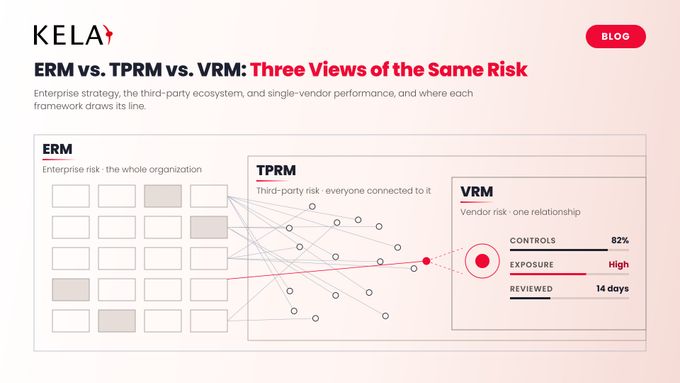
ERM, TPRM, and VRM are three different frameworks, not three names for the same one. ERM governs risk across the whole organization, TPRM governs the external parties it depends on, and VRM governs how a named vendor performs against its contract. They sit at different levels, answer to different owners, and report on different clocks. Confusing them is how organizations end up assessing every supplier with the same questionnaire while nobody owns the aggregate exposure.
In this blog, we look at how key risk management frameworks operate and how threat intelligence can help organizations identify emerging risks earlier, validate risk assessments, and strengthen overall resilience.
» Skip to the solution: Try KELA for free
Brief Overview: ERM vs. TPRM vs. VRM
Enterprise Risk Management
Enterprise Risk Management (ERM) provides a strategic, organization-wide framework for identifying and managing risks that could affect business objectives. It focuses on high-level threats such as financial instability, regulatory exposure, market shifts, and operational disruption.
ERM is typically governed by executive leadership and the board, ensuring that risk tolerance aligns with long-term strategy.
Third-Party Risk Management
Third-Party Risk Management (TPRM) manages risks introduced by external organizations such as suppliers, contractors, partners, and service providers.
It focuses on assessing external relationships before and during engagement, ensuring these parties meet security, compliance, and operational standards.
Vendor Risk Management
Vendor Risk Management (VRM) focuses on specific vendor relationships, particularly those providing products or services that support daily operations.
It emphasizes vendor performance, contractual obligations, and ongoing compliance throughout the lifecycle of the vendor relationship.
» Learn more about the cybercrime threats coming in 2026
A Quick Comparison of Risk Frameworks
Before going into the details of each framework, here’s a brief summary showing how ERM, TPRM, and VRM differ in scope, focus, and responsibilities.
Aspect | ERM | TPRM | VRM |
|---|---|---|---|
Scope | Enterprise-wide, covering all organizational risks | Focuses on risks introduced by third-party relationships | Focuses on individual vendor performance and contractual obligations |
Ownership | Senior leadership and board oversight | Collaboration between compliance, IT, procurement, and risk teams | Contract owners, IT operations, and service managers |
Risk Focus | Strategic, financial, operational, and regulatory risks across the organization | External risks, including security, compliance, and vendor reliability | Operational and performance risks related to active vendor contracts |
Monitoring & Reporting | Periodic, strategic reporting (quarterly/annual) to executives and board | Continuous or event-driven, reviewed by procurement, compliance, and security teams | Frequent, operational reporting (monthly or continuous) to contract owners and operations teams |
Technology Support | Enterprise GRC platforms, dashboards, heat maps, compliance tracking | Vendor lifecycle and risk assessment platforms, automated questionnaires, document management | Vendor performance tracking tools, SLA monitoring, scorecards, contract management integration |
Key Outcome | Enterprise-wide risk visibility, strategic alignment, informed decision-making | Reduced exposure to third-party risks, proactive vendor management | Consistent vendor performance, contractual accountability, operational resilience |
Key Operational Differences Between ERM, TPRM, and VRM
While ERM, TPRM, and VRM are all essential components of a resilient business, they operate at different levels of the organization and focus on distinct layers of risk, ranging from high-level corporate strategy to the technical performance of specific service providers.
Organizational Scope and Risk Coverage
One of the most significant differences between ERM, TPRM, and VRM lies in how broadly each framework evaluates risk across the organization and its external environment.
How Scope Functions in ERM
ERM evaluates risks that could affect the entire organization and its strategic objectives. Instead of focusing on specific departments or relationships, it assesses how threats may influence overall performance, reputation, and financial stability.
Typical ERM risk areas include:
- Strategic competition or market disruption
- Regulatory or compliance exposure
- Financial volatility or economic shifts
- Operational failures affecting multiple business units
Because ERM operates at the enterprise level, risk discussions often take place within executive committees and board meetings.
How Scope Functions in TPRM
TPRM focuses on external relationships that introduce risk into the organization's ecosystem. The scale is larger than most programs assume and unevenly distributed: in the 2025 EY Global Third-Party Risk Management Survey of 500 executives, TPRM programs less than three years old actively managed a median of 275 third parties, while programs more than a decade old managed a median of 80, having narrowed their panel through risk-based prioritization. Each relationship can introduce operational, cybersecurity, and compliance issues originating outside the organization, and each of those third parties brings its own subcontractors with it.
TPRM programs evaluate risks such as:
- Third-party access to sensitive customer or financial data
- Dependence on external cloud or infrastructure providers
- Compliance exposure created by outsourced services
- Vendor financial stability and long-term reliability
These assessments usually involve multiple departments, including procurement, IT security, compliance, and legal.
» Confused? Here's our guide to navigating third-party cyber threats
How Scope Functions in VRM
VRM takes a more relationship-specific approach by focusing on the performance and reliability of individual vendors. Instead of evaluating the entire external ecosystem, VRM ensures that each vendor delivers services according to agreed expectations.
Key VRM concerns typically include:
- Contractual service commitments
- Operational reliability and service uptime
- Delivery timelines and performance metrics
- Vendor responsiveness during operational disruptions
This makes VRM particularly important for organizations that rely on vendors to support critical services or infrastructure.
Risk Identification and Assessment Approaches
Another major difference between the frameworks is how risks are discovered and evaluated.
Risk Identification in ERM
ERM uses a top-down assessment model that begins with strategic objectives. Leadership evaluates what risks could prevent the organization from achieving those objectives and then maps those risks across business units.
Common ERM assessment tools include:
- Enterprise risk registers
- Impact-likelihood risk matrices
- Strategic risk workshops
- Scenario analysis and stress testing
For example, an ERM assessment may examine how a recession could affect revenue growth or how regulatory changes could alter market access.
Risk Identification in TPRM
TPRM relies heavily on due diligence and third-party assessments. Organizations evaluate potential vendors before onboarding them and periodically reassess them during the relationship.
Typical TPRM assessment methods include:
- Vendor security questionnaires
- Financial health reviews
- Compliance documentation verification
These evaluations help organizations understand whether a third party introduces unacceptable security or operational risk.
» Learn more: Why Third-Party risk in healthcare demands immediate attention
Risk Identification in VRM
VRM focuses on ongoing monitoring after a vendor relationship begins. Instead of pre-engagement evaluation, the framework ensures that vendors continue meeting operational and contractual expectations.
Examples of VRM monitoring activities include:
- Reviewing service-level agreement (SLA) performance
- Monitoring vendor system uptime metrics
- Conducting periodic vendor performance reviews
- Tracking remediation actions following security incidents
Because vendors directly affect operational reliability, this monitoring tends to be more frequent and operationally focused.
Risk Categorization and Prioritization
Although all three frameworks classify risk, the criteria used to prioritize threats differ significantly.
Risk Prioritization in ERM
ERM prioritizes risks according to their impact on strategic and financial outcomes. Risks that threaten organizational survival, market position, or regulatory compliance receive the highest priority.
Typical ERM risk categories include:
- Strategic risk
- Financial risk
- Operational risk
- Reputational risk
These risks are often visualized using enterprise risk heat maps to help leadership identify the most critical threats.
Risk Prioritization in TPRM
TPRM prioritizes risk based on the level of access and dependency associated with each third party.
For example, a vendor that processes sensitive customer data or operates core infrastructure will be classified as higher risk than a supplier delivering office supplies.
Common TPRM prioritization factors include:
- Data sensitivity handled by the vendor
- Access to internal systems
- Criticality of services provided
- Geographic or regulatory exposure
» Learn more: The anatomy of a third-party vendor assessment
Risk Prioritization in VRM
VRM prioritizes risks related to vendor performance and contract compliance.
Operational indicators often determine priority, such as:
- Repeated SLA violations
- Service outages affecting business operations
- Security incidents linked to vendor systems
- Failure to meet contractual obligations
These operational signals can trigger vendor remediation programs or contract renegotiation.
Implementation Processes and Program Development
The implementation of ERM, TPRM, and VRM differs mainly in when the framework is introduced and what part of the organization it governs.
Implementation Process in ERM
ERM implementation usually begins with enterprise governance and policy development. Senior leadership defines how the organization approaches risk by establishing a formal risk appetite and aligning it with strategic objectives. From there, organizations build internal structures that support risk oversight, such as executive risk committees and cross-department reporting processes.
As the program develops, ERM typically introduces several foundational components. These often include the creation of a centralized enterprise risk register that captures risks across departments, the assignment of risk owners responsible for monitoring and mitigation, and the integration of risk assessments into business planning processes.
Implementation Process in TPRM
TPRM programs are usually introduced when organizations begin engaging with external partners or service providers. Risk management becomes a formal part of the procurement and onboarding process to ensure that third parties do not introduce security, compliance, or operational vulnerabilities.
Implementation generally begins with vendor risk screening during procurement, where potential partners are evaluated according to the level of access they will have to internal systems or sensitive data. Before contracts are finalized, organizations often perform security and compliance assessments, which may involve reviewing certifications, security documentation, and operational controls.
Contracts then include specific clauses outlining security expectations, data protection obligations, and operational requirements. Once the relationship begins, the TPRM program continues through periodic monitoring and reassessment to confirm that the third party maintains acceptable risk levels throughout the partnership.
» Make sure you know how threat actors breach and exploit your data
Implementation Process in VRM
VRM implementation occurs after a vendor relationship has been formally established. While TPRM focuses heavily on pre-engagement evaluation, VRM concentrates on managing the vendor’s operational performance during the contract lifecycle.
The program typically begins by establishing service-level agreements (SLAs) that clearly define expectations for service delivery, uptime, response times, and other operational benchmarks. Organizations then monitor vendor performance against these commitments using measurable indicators and reporting systems.
Regular vendor review meetings are often held to evaluate performance results, address operational issues, and discuss potential improvements. If performance issues arise, the VRM program may initiate remediation plans or improvement strategies to ensure the vendor continues to meet contractual and operational standards.
» Make sure you understand the difference between vulnerability, threat, and risk to strengthen your cybersecurity strategy

Stay Ahead With KELA Cyber
KELA delivers real-time cyber threat intelligence to help you identify, monitor, and mitigate risks across your supply chain.
Technology and Platform Support
Risk management frameworks rely increasingly on digital platforms to consolidate, organize, and analyze risk information, and on centralizing the function that runs them: EY's 2025 survey found 57% of organizations operating a centralized, enterprise-wide TPRM program, up from 54% in 2023.
Technology Supporting ERM
ERM platforms typically exist within Governance, Risk, and Compliance (GRC) systems. These tools help organizations aggregate risk data from across departments and present it in a way that supports strategic decision-making at the executive level.
Common ERM platform capabilities include:
- Enterprise risk dashboards that provide a centralized overview of organizational risk exposure across departments.
- Strategic risk heat maps that visualize the likelihood and potential impact of different risks.
- Integrated compliance tracking that connects regulatory requirements with risk monitoring processes.
- Risk reporting tools that generate structured insights for executive leadership and board-level discussions.
Technology Supporting TPRM
TPRM platforms focus on managing the lifecycle of third-party relationships while automating vendor risk assessments. These systems help organizations evaluate potential vendors before engagement and maintain oversight throughout the partnership.
Typical functionality includes:
- Vendor onboarding workflows that guide procurement and risk teams through the initial vendor evaluation process.
- Automated questionnaire distribution systems that collect security and compliance information directly from third parties.
- Document management tools that store certifications, security policies, and compliance reports provided by vendors.
- Continuous monitoring capabilities that track vendor risk ratings and alert organizations to changes in security posture or compliance status.
Technology Supporting VRM
VRM tools emphasize vendor performance monitoring and operational oversight. These platforms allow organizations to track whether vendors are meeting contractual obligations and delivering services according to agreed standards.
Examples of VRM platform features include:
- Service-level agreement (SLA) performance tracking that measures vendor service delivery against contractual commitments.
- Vendor scorecards and performance dashboards that evaluate service quality and reliability over time.
- Integration with contract management systems to maintain visibility into vendor obligations and contractual requirements.
- Operational monitoring tools that track metrics such as service uptime, incident response times, and overall service reliability.
» Concerned about the future? See these other trends shaping the future of CTI or check out our future of cybercrime podcast
Monitoring, Reporting, and Risk Communication
The cadence, audience, and focus of monitoring and reporting differ significantly between ERM, TPRM, and VRM, reflecting the different purposes of each framework.
Monitoring in ERM
- ERM monitoring is strategic and periodic, with reports typically produced on a quarterly or annual basis for executive leadership and the board of directors.
- Reports focus on enterprise-level indicators, including the organization’s strategic risk exposure, projected financial losses, and overall regulatory compliance status.
- Data from operational and third-party risk programs is aggregated in ERM dashboards to provide leadership with a high-level overview that supports decision-making and strategic planning.
- ERM monitoring helps align risk management with long-term business objectives and informs adjustments to the organization’s risk appetite.
Monitoring in TPRM
- TPRM monitoring occurs continuously throughout the lifecycle of third-party relationships and is often triggered by contract renewals, risk assessments, or security incidents.
- Reports are reviewed by procurement managers, compliance officers, and information security teams who require insight into the risks posed by external partners.
- Key metrics tracked in TPRM include vendor risk scores, compliance certifications, results of security audits, and ongoing assessments of third-party controls.
- Continuous TPRM reporting allows organizations to identify emerging risks, take corrective action quickly, and ensure that third-party engagements remain aligned with organizational risk tolerance.
Monitoring in VRM
- VRM monitoring is operational, detailed, and frequent, often occurring monthly or continuously for critical vendors.
- Reports are intended for contract owners, IT operations teams, and service managers who are responsible for day-to-day vendor performance.
- Metrics monitored in VRM include system uptime percentages, SLA compliance rates, incident response times, and adherence to service delivery timelines.
- Regular VRM monitoring ensures that vendors meet contractual and operational obligations, allows early detection of performance gaps, and supports remediation or improvement initiatives.
» Not convinced? Here are some more reasons you need cyber threat intelligence
Cyber Threat Intelligence
Detect early signs of data breaches and third-party exposure with KELA’s threat intelligence insights.
How KELA Cyber Can Help
ERM, TPRM, and VRM provide strong frameworks, but emerging threats such as insider misuse, supply chain disruptions, and geopolitical events require additional intelligence. At KELA Cyber, we help organizations address these gaps by monitoring the dark web and criminal forums to detect insider threats before they escalate.
Our TPRM module continuously monitors third-party attack surface and produces a predictive risk score for each vendor, adjusting as new intelligence surfaces, so TPRM teams can act on the vendors that matter rather than the ones that answered the questionnaire fastest. Vendor assets are discovered and catalogued without questionnaires or vendor consent, and the top risks are prioritized per vendor with recommended corrective measures.
Additionally, KELA validates and refines risk scores in TPRM systems with evidence-based intelligence, helping organizations prioritize high-impact risks and improve recovery readiness.
» Ready to begin? Contact us to learn more about our third-party intelligence
FAQs
What is the main difference between ERM, TPRM, and VRM?
ERM is the "big picture" strategy covering the entire company's goals. TPRM is the "ecosystem" view that looks at all external partners (suppliers, partners, etc.), while VRM is the "micro" view focusing on the day-to-day performance of specific service vendors.
Who is responsible for managing these frameworks?
ERM is typically owned by the Board and executive leadership. TPRM is usually managed by procurement, legal, and cybersecurity teams. VRM is handled by the specific department using the service, such as IT operations or a business unit manager.
How does ERM benefit from TPRM and VRM data?
ERM relies on "upward reporting." If a specific vendor fails (VRM) or a third-party data breach occurs (TPRM), that data flows up to the ERM level to help leaders calculate the total financial and reputational impact on the company.
Which framework should an organization implement first?
Ideally, ERM should come first to define the organization's "risk appetite." This sets the standard for how much risk is acceptable, which then dictates the rules for how TPRM and VRM evaluate external partners and vendors.