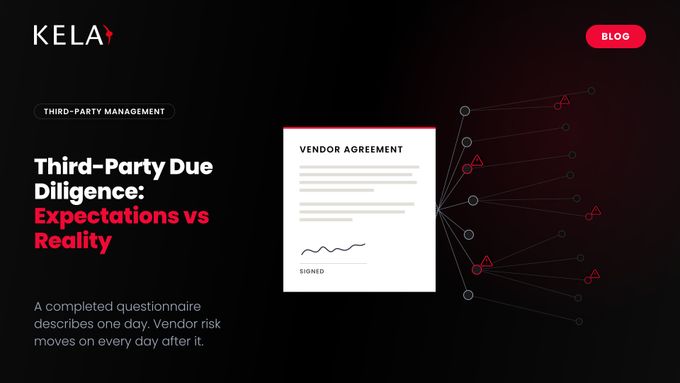
Third-Party Due Diligence (TPDD): Expectations vs. Reality
Third-party due diligence is the process of assessing a vendor's security, compliance, financial stability and overall risk before and during a business relationship. This guide covers what TPDD is, how it fits inside a wider third-party risk management program, and the five components of a mature program. It also covers where questionnaire-led due diligence stops short, and what continuous monitoring adds after onboarding.




Published September 4, 2026
When you bring a new partner into your business, you are essentially opening your front door to them. Before you hand over keys to your systems, data, or customers, you need to know exactly who they are and how they operate. This is the goal of third-party due diligence (TPDD): the essential process of verifying a partner before you sign a contract. Many companies make the mistake of waiting until a crisis occurs to realize that their vetting process was only skin-deep.
In 2021 research by the Ponemon Institute, sponsored by SecureLink, 51% of organizations reported a data breach caused by a third party. The start of a relationship is where that risk is cheapest to catch. In this blog, we’ll explore how to move beyond basic checklists and actually manage your risk.
Strengthen your third-party due diligence with KELA Cyber
What is TPDD?
The goal is to understand whether a vendor, supplier, service provider, or other external partner can meet your organization's standards and operate without introducing unnecessary risk.
Rather than waiting for issues to arise after onboarding, TPDD takes a proactive approach by identifying potential concerns early in the evaluation process. This helps organizations make informed decisions about who they work with, protect sensitive data and critical systems, reduce operational and compliance risks, and safeguard their reputation throughout the relationship.
How TPDD Fits into the Third-Party Risk Management Lifecycle
Third-party due diligence is one part of a broader third-party risk management (TPRM) program. While TPDD focuses on evaluating a third party before and during the relationship, it works alongside several other processes that help organizations manage risk throughout the entire vendor lifecycle.
A typical third-party risk management lifecycle includes the following stages:
- Onboarding: Verify that the vendor is a legitimate business and perform initial screening to identify obvious legal, financial, or reputational risks.
- Due diligence: Conduct a detailed assessment of the vendor's security, compliance, financial stability, operational capabilities, and overall risk profile to determine whether they meet your organization's requirements.
- Contracting: Establish contractual terms, security obligations, service expectations, and compliance requirements based on the findings of the due diligence process.
- Ongoing monitoring: Continuously monitor the vendor's security posture, regulatory compliance, financial health, and performance to identify changes in risk over time.
- Offboarding: Remove the vendor's access to systems and data, ensure information is returned or securely destroyed, and formally close the relationship to prevent ongoing risk.
» Learn more: The anatomy of a third-party vendor assessment
The Risks You Are Inheriting
Every third-party relationship introduces a level of risk to your organization. Whether a vendor has access to sensitive data, critical systems, or essential business processes, their weaknesses can quickly become your organization's vulnerabilities.
Third-party due diligence helps identify and assess these risks before a partnership begins, allowing organizations to make informed decisions and implement appropriate risk controls.
Some of the most common areas of third-party risk include:
- Security risks: Weak cybersecurity controls, vulnerable systems, or poor security practices can increase the likelihood of a data breach or unauthorized access to your environment.
- Fourth-party risks: Many vendors rely on subcontractors and service providers to deliver their services. These extended supply chain relationships can introduce additional risks that may not be immediately visible without proper due diligence.
- Operational risks: A vendor that lacks sufficient resources, resilience, or business continuity capabilities may struggle to maintain service availability during disruptions, affecting your own operations.
- Reputational risks: Regulatory violations, unethical practices, public controversies, or other incidents involving a third party can negatively impact your organization's reputation and customer trust.
- Financial risks: Financial instability may reduce a vendor's ability to deliver services effectively, invest in security, or meet long-term contractual commitments.
» Here's everything you need to know about third-party risk management
Business Outcomes of an Effective TPDD Program
Better Decision-Making
An effective TPDD process provides meaningful insights rather than simply generating documentation. The findings enable organizations to make informed decisions, such as requiring a vendor to address identified risks before onboarding, limiting access to sensitive systems, or selecting a lower-risk alternative.
Stronger Contract Negotiations
Due diligence findings provide a stronger foundation for contract negotiations. Organizations can include security requirements, service level expectations, breach notification obligations, audit rights, and termination clauses that reflect the level of risk identified during the assessment.
Greater Supply Chain Visibility
TPDD improves visibility into a vendor's broader ecosystem, including subcontractors and other third parties that support service delivery. This helps organizations understand where additional risks may exist and manage dependencies more effectively.
Reduced Financial and Operational Impact
Identifying and addressing third-party risks before they lead to an incident can reduce the likelihood and impact of security breaches, service disruptions, compliance issues, and other costly business events. Over time, this contributes to a more resilient and secure third-party ecosystem.
» Learn how supply chain threat intelligence strengthens your security posture
The Limitations of Traditional Third-Party Due Diligence
Many traditional third-party due diligence processes rely on self-reported questionnaires and compliance certifications. While these provide valuable evidence, they only reflect a vendor's security posture at a specific point in time and may not accurately represent their current level of risk.
The SolarWinds Lesson
The SolarWinds supply chain attack highlighted this limitation. As the U.S. Government Accountability Office describes it, the threat actor breached SolarWinds' own network and injected trojanized code into a file that then shipped inside legitimate Orion product updates: a compromise of the build and release pipeline, which is not something a questionnaire is designed to detect.
This demonstrates why mature TPDD programs go beyond compliance checklists by incorporating continuous monitoring and threat intelligence alongside traditional assessments, providing a more accurate view of third-party risk throughout the vendor lifecycle.
» Confused? Here's our guide to navigating third-party cyber threats
5 Key Components of a Mature Third-Party Due Diligence Program
A mature due diligence program operates as a single, integrated engine rather than a collection of separate tasks. Effectiveness is not defined by how sophisticated one part is, but by how well the pieces work together across the entire vendor relationship.
1. Risk-Based Vendor Tiering
Every TPDD program should begin with a risk-based tiering framework that classifies third parties according to the level of risk they introduce. Rather than applying the same level of scrutiny to every vendor, organizations should assess each third party based on factors such as:
- Access to sensitive or regulated data
- Level of system integration
- Operational dependency and business criticality
- Regulatory and compliance requirements
- Geographic location and jurisdictional exposure
- Access to critical infrastructure or business processes
These factors determine a vendor's risk tier, which in turn defines the scope of the assessment, the evidence required, and the frequency of reassessments. This risk-based approach enables organizations to allocate resources efficiently while applying greater oversight to vendors that present the highest level of risk.
2. Initial Vendor Screening
Before conducting a detailed assessment, organizations should perform an initial screening to identify obvious risks that could prevent a business relationship from moving forward. This preliminary review typically evaluates:
- Sanctions and watchlist exposure
- Adverse media and reputational concerns
- Financial stability and business viability
- Regulatory enforcement history
- Legal disputes and litigation history
- Corporate ownership and beneficial ownership structures
- Basic compliance and licensing status, where applicable
Conducting these checks early in the due diligence process helps organizations identify unsuitable vendors before investing significant time and resources in comprehensive assessments. It also enables risk teams to prioritize vendors that warrant further investigation while eliminating those that present unacceptable legal, financial, operational, or reputational risks.
3. Structured Risk Assessments
Following initial screening, organizations should conduct a structured assessment appropriate to the vendor's risk tier. The scope of the assessment should be proportionate to the level of risk identified and may include:
- Security questionnaires aligned with recognized frameworks
- Evidence reviews of security controls and policies
- Compliance certifications and supporting documentation
- External attack surface analysis
- Vulnerability assessments and external security testing
- Business continuity and disaster recovery capabilities
- Data protection and privacy controls
- Technical interviews with key stakeholders
- On-site assessments or audits for critical or high-risk vendors
Using a standardized assessment methodology ensures that vendors are evaluated consistently and that results can be compared across the entire third-party ecosystem.
» Make sure you understand the difference between vulnerability, threat, and risk to strengthen your cybersecurity strategy
4. Risk-Informed Contract Management
Due diligence findings should directly influence contractual requirements rather than being treated as a separate exercise. Contract terms should be tailored to the level of risk identified during the assessment and commonly include:
- Security and compliance obligations
- Breach notification requirements
- Audit and assessment rights
- Data protection and privacy clauses
- Subprocessor approval or disclosure requirements
- Service level agreements (SLAs)
- Data return and secure destruction requirements
- Contract termination and exit provisions
Aligning contractual obligations with identified risks helps ensure that vendors are held to appropriate security, compliance, and operational standards throughout the relationship.
5. Continuous Monitoring and Reassessment
Vendor risk does not remain static after onboarding. Security incidents, financial challenges, regulatory actions, ownership changes, or newly discovered vulnerabilities can significantly alter a vendor's risk profile over time. A continuous monitoring program should track key indicators such as:
- Changes to the vendor's external attack surface
- New vulnerabilities or security incidents
- Regulatory or compliance developments
- Financial health and business stability
- Adverse media and reputational issues
- Changes in ownership or corporate structure
- Emerging threat intelligence relevant to the vendor
Continuous monitoring, combined with periodic reassessments, enables organizations to identify changes in vendor risk early and respond with appropriate reviews, remediation activities, or contractual actions throughout the relationship.

Monitor Vendor Risk with KELA
Gain continuous visibility into third- and fourth-party cyber risks to identify high-risk vendors and prioritize remediation with real-world threat intelligence.
» Get started with KELA for free
How KELA Supports Third-Party Due Diligence Across the Vendor Lifecycle
KELA Cyber strengthens third-party due diligence by providing continuous threat intelligence throughout the vendor lifecycle. Rather than relying solely on questionnaires and compliance documentation, KELA delivers external visibility into vendor exposure, helping organizations identify risks before onboarding and monitor changes long after contracts have been signed.
Third-Party Attack Surface Monitoring
KELA's Third-Party Risk Management (TPRM) module discovers the digital assets associated with a vendor, collects threat intelligence and attack surface findings against them, and assigns a risk score that moves as new findings arrive. Monitoring is permission-less, so a vendor can be assessed without waiting on a completed questionnaire or a signed consent form. That is what makes external assessment usable at the screening stage, and not only after a vendor has been onboarded.
Strengthening Mergers and Acquisitions Due Diligence
During mergers and acquisitions (M&A), organizations inherit not only the target company's assets but also its third-party relationships. KELA enables security teams to rapidly assess the acquired vendor ecosystem by identifying exposed credentials, dark web activity, external attack surface weaknesses, and other indicators of cyber risk.
These insights can help inform acquisition decisions, prioritize post-merger remediation efforts, and reduce inherited third-party risk.
Accelerating Vendor Incident Response
When a third party experiences a security incident, organizations need immediate visibility into the potential impact. KELA provides intelligence on threat actor discussions, compromised credentials, leaked data, and other underground activity to help determine the scope of exposure and whether additional vendors within the supply chain may also be affected.
This enables faster incident response and more informed decisions regarding customer notifications, contractual obligations, and ongoing vendor relationships.
Prioritizing Third-Party Risk with Threat Intelligence
KELA's Threat Landscape module provides broader visibility into the cybercrime ecosystem, ranking the sectors, geographies and threat actors most often documented in tracked activity such as ransomware events and network accesses offered for sale.
This intelligence helps organizations prioritize vendor assessments, continuous monitoring, and remediation efforts based on current threat activity, ensuring resources are focused on the areas of greatest risk.
» Worried about security? Here are the reasons you need cyber threat intelligence
Secure Your Ecosystem with Proactive Due Diligence
Third-party due diligence is more than a one-time assessment. The takeaway is that due diligence which stops at signature only ever describes the vendor you onboarded, not the vendor you have today. It helps organizations understand who they are doing business with, identify potential risks early, and make informed decisions before those risks affect the business.
As supply chain threats continue to evolve, organizations need visibility beyond the onboarding stage. Continuous monitoring and real-time threat intelligence from KELA Cyber help security and risk teams identify changes in vendor risk, prioritize high-risk third and fourth parties, and strengthen their overall third-party risk management program.
» Ready to begin? Contact us to learn more about our third-party intelligence
FAQs
What is third-party due diligence (TPDD)?
Third-party due diligence (TPDD) is the process of evaluating a vendor's security, compliance, financial stability, and overall risk before and throughout a business relationship.
Why is third-party due diligence important?
It helps organizations identify and manage security, operational, financial, and reputational risks introduced by third parties.
What is the difference between TPDD and third-party risk management (TPRM)?
TPDD is one part of a broader third-party risk management (TPRM) program, which manages vendor risk throughout the entire relationship.
Why is continuous monitoring important?
Continuous monitoring helps identify changes in a vendor's risk profile between formal assessments, allowing organizations to respond more quickly to emerging threats.