NIST Third Party Risk Management: A Complete Strategic Guide
This blog explains how NIST frameworks guide effective third-party risk management across modern vendor ecosystems. It breaks down CSF 2.0 functions, key NIST publications, and how organizations can move from static assessments to a structured, continuous approach that improves visibility, control, and vendor oversight.




Published September 4, 2026
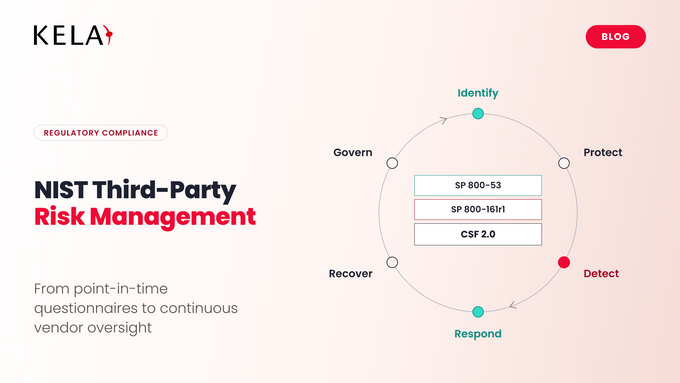
NIST third party risk management is a risk-based approach to vendor and supplier security that applies NIST SP 800-53 controls, NIST SP 800-161r1 supply chain guidance, and the NIST Cybersecurity Framework 2.0 governance layer across the whole vendor lifecycle.
Managing the security of external partners has become a core part of how organizations operate today. As businesses rely on a growing number of suppliers, service providers, and SaaS platforms, third-party risk naturally extends into nearly every part of the operational environment.
Third-party risk accumulates quickly across supply chains when it is not structured and understood in a consistent way, and even well-managed organizations struggle to maintain visibility across all vendors and their dependencies. Even well-managed organizations can struggle to maintain visibility across all vendors and their associated dependencies.
This guide breaks down the NIST approach to third-party risk management (TPRM) and shows how it can be applied in practice to strengthen day-to-day operations. It explores how structured governance, clear assessment processes, and continuous insight into vendor activity come together to support better oversight of third-party relationships.
» Ensure your third-party risk management is up to standard with KELA
What You Need to Know: Defining NIST TPRM
At its core, a NIST-aligned TPRM approach is a risk-based program that applies standardized security controls, supply chain oversight, and continuous monitoring to manage vendor and supplier risks. Rather than being a single tool or a rigid certification, it is a flexible, outcome-based framework that provides guidance rather than mandates.
The program relies on a layered combination of essential publications:
- NIST SP 800-53: This provides the baseline set of security and privacy controls used to protect information systems. It forms the technical foundation for assessing whether vendors meet minimum security requirements.
- NIST SP 800-161r1: This publication focuses on supply chain risk management. It expands the scope beyond direct vendors to include fourth-party dependencies, helping organizations understand deeper layers of exposure across the supply chain.
- NIST Cybersecurity Framework (CSF) 2.0: This acts as the governance layer that ties everything together. It aligns security outcomes across the organization and helps ensure that third-party risk management is consistent with broader cybersecurity objectives.
» Learn how supply chain threat intelligence strengthens your security posture
Benefits of a NIST Approach to Third-Party Risk
Building your program on NIST guidance offers several foundational advantages for your organization:
- Standardized language: By utilizing common frameworks like NIST CSF 2.0 and NIST SP 800-161, your team creates a consistent way to evaluate hundreds or thousands of vendors instead of relying on fragmented, ad hoc reviews.
- Risk-based prioritization: You can tier vendors by criticality, access levels, and data sensitivity, allowing you to focus deep assessments on high-risk partners while streamlining reviews for lower-risk entities.
- Proactive threat visibility: NIST encourages integrating external threat intelligence and continuous monitoring into your lifecycle, moving your team from reactive annual reviews to identifying compromises in near real-time.
» Worried about security? Here are the reasons you need cyber threat intelligence
Why NIST Matters in Third-Party Risk
The strategic value of NIST in third-party risk management becomes clearer when it is applied as a governance and resilience model rather than a documentation exercise.
Vendor inventories at most organizations now run into the hundreds, spanning cloud services, SaaS platforms, and outsourced operations, and each relationship widens the exposure that has to be governed. The Verizon DBIR puts third-party involvement at 48% of breaches in its 2026 edition, up 60% year over year, across incidents from November 2024 to October 2025.
A key challenge is the gap between control existence and control effectiveness.
Vendors routinely attest to controls that are never independently confirmed, and confirmation is slow when it does happen: in the 2026 DBIR dataset, only 23% of third-party organizations fully remediated missing or improperly secured MFA on their cloud accounts. Vendors may confirm protections like MFA, encryption, or secure development practices, but these controls can vary across environments, integrations, and subcontractors.
Additional context from NIST SP 800-161 highlights the importance of fourth-party risk, where exposure often originates through indirect suppliers, cloud dependencies, or embedded software components that are not always visible in standard assessments.
» Read more why NIST and CTI are the perfect match for building a cyber resilient organizations
NIST CSF 2.0 and the Structure of a Mature TPRM Program
Organizations should map the six core functions of NIST CSF 2.0, Govern, Identify, Protect, Detect, Respond, and Recover, to the full vendor lifecycle to ensure resilience.
In practice, these functions are applied across onboarding, due diligence, ongoing monitoring, and offboarding, so third-party risk is managed consistently rather than in isolated stages.
- Govern (GV): Establish the overarching strategy, risk appetite, and policies that define how your organization oversees third-party risk at the board and leadership level.
- Identify (ID): Gain total visibility by mapping all third parties, SaaS dependencies, data flows, and fourth-party relationships to understand the business context of your ecosystem.
- Protect (PR): Implement security safeguards through contractual obligations, such as mandatory multi-factor authentication (MFA), encryption, and specific incident reporting timelines.
- Detect (DE): Use continuous monitoring and external intelligence to spot potential threats, vulnerabilities, or leaked credentials as they emerge throughout the relationship.
- Respond (RS): Maintain clear, pre-defined playbooks for containing vendor-related incidents to prevent cascading operational damage across your network.
- Recover (RC): Ensure you have tested recovery plans to restore business operations quickly and effectively following a supplier disruption.
The key point is that these six functions only work as an operating model when they run continuously: third-party risk managed across governance, technical controls, and external threat conditions, rather than reviewed at fixed intervals.
» Confused? Here's our guide to navigating third-party cyber threats
Implementing NIST Third-Party Risk Management in Practice
A NIST-aligned TPRM program should not be treated as a static onboarding checklist. Instead, it needs to function as a continuous vendor lifecycle model where risk is managed from initial engagement through to offboarding and ongoing oversight.
The process is intentionally cyclical, ensuring that vendor risk is continuously reassessed rather than reviewed at fixed intervals.
The 8-Step Vendor Risk Lifecycle
1. Governance & Policy
Every effective TPRM program starts with governance. This means defining clear ownership, accountability, and an enterprise risk appetite. Without executive-level mandate and policy alignment, enforcement tends to remain inconsistent across business units.
2. Vendor Inventory
You cannot manage risk without visibility. A complete, centralized register of all vendors- including SaaS providers, contractors, service providers, and fourth-party dependencies forms the foundation of the program. This ensures no external dependency is overlooked.
3. Risk Tiering
Not all vendors carry the same level of risk. Tiering allows you to classify vendors based on factors such as data sensitivity, system access, and operational criticality. This prioritization ensures that effort and resources are focused on the highest-impact relationships.
4. Due Diligence
Assessment should go beyond basic questionnaires. A mature program requires verifiable evidence such as SOC 2 Type II reports, ISO 27001 certifications, penetration test summaries, and other independently validated security artifacts.
5. Contract Controls
Security expectations must be contractually enforced. Agreements should clearly define obligations such as security requirements, breach notification timelines, audit rights, and secure data disposal requirements at contract termination. Notification windows are commonly negotiated in the 24 to 72 hour range, though the binding figure is whatever the applicable regime sets: GDPR requires notification to the supervisory authority without undue delay and within 72 hours of awareness.
6. Continuous Monitoring
Risk does not remain static after onboarding. Continuous monitoring introduces real-time or near-real-time visibility through threat intelligence feeds, external security ratings, and automated scanning to detect changes in vendor risk posture between formal assessments.
7. Incident Response & Recovery
Critical vendors should be embedded into incident response planning. This includes integrating them into response playbooks, escalation paths, and tabletop exercises to ensure coordinated action during security events.
8. Review & Improve
A mature TPRM program evolves over time. Performance metrics and KPIs should be used to evaluate effectiveness, refine risk tiering logic, and incorporate lessons learned to continuously strengthen the operating model.
» Here's everything you need to know about TPRM

Advanced TPRM Security
KELA provides an intelligence-led TPRM module that strengthens visibility and control over third-party and supply chain risk.
Common NIST TPRM Mistakes and What to Avoid
The most frequent failure is treating NIST as a "checkbox exercise" where security is only documented rather than operationalized.
- Static assessments: Never rely on annual reviews alone; vendor environments can shift in days due to new vulnerabilities or data leaks.
- "One-size-fits-all" models: Do not apply the same 300-question assessment to every supplier, as this leads to "questionnaire fatigue" and slows down procurement.
- Security-only silos: Do not leave TPRM solely to the IT team; ensure procurement, legal, and business units are integrated to prevent "shadow IT".
- Lack of validation: Do not rely on "Yes/Compliant" answers without requiring evidence such as penetration test results or configuration reviews.
How KELA Cyber Supports NIST Third-Party Risk Management
KELA Cyber supports NIST-aligned TPRM by acting as the real-time intelligence layer in your vendor lifecycle. Unlike static documents, KELA continuously monitors cybercrime sources for evidence of vendor compromise, including dark net forums, markets and paste sites, closed instant messaging channels, and automated markets trading access to infected machines.
- Exposure intelligence: KELA identifies leaked credentials, compromised network access, and credentials taken from machines infected with infostealer malware, so vendor exposure surfaces during your window to act on it rather than after.
- Continuous monitoring: By tracking the "attacker's-eye view" of your supply chain, KELA helps you move beyond point-in-time assessments to real-time risk visibility.
- Prioritized escalation: If a critical vendor is mentioned on the dark web, KELA provides the alerts needed to trigger immediate reassessments, fulfilling the Detect (DE) and Respond (RS) functions of the NIST framework.
» Make sure you understand the difference between vulnerability, threat, and risk to strengthen your cybersecurity strategy
Building Resilience Through Intelligence
NIST-aligned TPRM focuses on maintaining a clear and continuous understanding of third-party risk across the vendor ecosystem. It brings together governance, structured assessment, and ongoing insight into how supplier exposure changes over time.
When the NIST Cybersecurity Framework 2.0 is combined with real-time intelligence from platforms such as KELA Cyber, organizations can connect formal third-party assessments with live signals from the threat landscape. This includes indicators like exposed credentials, vendor-related security incidents, and activity associated with cybercriminal groups.
By linking these inputs, organizations gain a more complete view of vendor risk and can make better-informed decisions about where attention is needed most. This strengthens oversight of critical suppliers and supports more consistent management of third-party exposure across the business.
» Ready to begin? Contact us to learn more about our third-party intelligence
FAQs
What is NIST third-party risk management (TPRM)?
NIST TPRM is a structured approach to managing risk introduced by vendors, suppliers, and service providers.
It uses frameworks such as NIST CSF 2.0, NIST SP 800-53, and NIST SP 800-161 to guide how organizations assess, monitor, and manage third-party relationships across their lifecycle.
Is NIST TPRM a compliance requirement?
No. NIST is a guidance framework rather than a strict compliance mandate. Organizations use it to design risk management programs that fit their environment, industry, and risk exposure. It is commonly adopted because it aligns well with other security standards and audit expectations.
Why is third-party risk so important today?
Most organizations rely on a large number of external vendors for critical services. This expands the attack surface beyond internal systems. Issues within a single vendor can impact multiple downstream customers and systems connected to that provider.
What is the difference between NIST SP 800-53 and NIST SP 800-161?
NIST SP 800-53 focuses on baseline security controls for systems and data protection. NIST SP 800-161 focuses specifically on supply chain risk management, including fourth-party dependencies and vendor lifecycle risks.
Why do traditional vendor questionnaires fail on their own?
Questionnaires often rely on self-attestation rather than verified evidence. While they provide a starting point, they do not confirm whether controls are actually implemented or operating effectively in real environments.