4 Third Party Risk Management Frameworks Every CISO Needs
The main third party risk management frameworks are CRF-TPRM, NIST 800-161, ISO 27036, and the Shared Assessments SIG. Each structures vendor oversight differently, and the right choice depends on your regulatory load and vendor count. Pairing any of them with continuous threat intelligence closes the gaps static assessments leave.




Published September 3, 2026
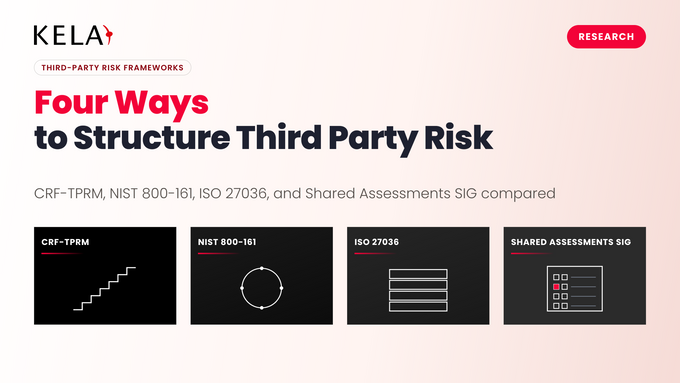
Four frameworks dominate third-party risk management: CRF-TPRM, NIST 800-161, ISO 27036, and the Shared Assessments SIG. Each gives you a structure to evaluate, monitor, and mitigate vendor threats before they escalate, and each suits a different kind of organization. Your vendors, suppliers, and service providers represent some of your biggest security blind spots.
Your vendors, suppliers, and service providers represent some of your biggest security blind spots. When one of them suffers a breach, your organization pays the price, in data loss, regulatory scrutiny, and reputational damage. Third-party risk management frameworks give you the structure to evaluate, monitor, and mitigate these external threats before they escalate. But not all frameworks serve the same purpose, and choosing the wrong one wastes resources while leaving critical gaps.
In this blog, we will break down the leading third-party risk management frameworks, their strengths and limitations, and how to select the right approach for your organization.
» Ensure your cybersecurity is up to standard with KELA
Third-Party Risk Management: A Quick Overview
Third-Party Risk Management (TPRM) has shifted from a compliance checkbox to a core pillar of organizational resilience. As companies become more interconnected through vendors, suppliers, cloud providers, and fourth-party networks, the exposure surface expands dramatically.
» Here's everything you need to know about third-party risk management
Why TPRM Has Become Non-Negotiable
Today’s organizations are under mounting pressure to formalize their Third-Party Risk Management frameworks, and the drivers behind this shift are clear and consistent across industries.
- Operational resilience is now a priority. With modern supply chains tightly interconnected, third parties introduce significant cybersecurity and continuity risks. In a 2021 Ponemon Institute study, 51% of organizations reported a data breach caused by a third party, which is why structured monitoring and due diligence are no longer optional.
- Regulatory mandates demand proof, not intent. Frameworks like GDPR and HIPAA require verifiable oversight of external partners, and the consequences for failing to manage these relationships go far beyond fines. Informal or ad-hoc vendor management simply can’t withstand today’s compliance expectations.
- Customer expectations shape business credibility. With around a quarter of organizations reporting reputational damage from third-party incidents, clients expect transparent, responsible handling of their data. A formal TPRM framework is now a core signal of trust and maturity.
» Learn how supply chain threat intelligence strengthens your security posture

Protect Your Supply Chain
KELA delivers real-time cyber threat intelligence, helping you identify, monitor, and mitigate risks across your supply chain.
Why Traditional Third-Party Assessments Fall Short
The old model of vendor questionnaires and periodic reviews cannot keep up with the pace and complexity of digital supply chains. These static assessments give a snapshot in time but fail to capture the evolving risks that sit within interconnected vendors and their subcontractors.
Traditional Approaches and Their Limitations
Traditional assessments rely on remote questionnaires, compliance checklists, and scheduled audits, none of which provide real-time assurance.
Attackers increasingly target supply chains, exploiting vendors as the weakest link. Even worse, only evaluating direct suppliers overlooks fourth-party risks that sit deeper in the ecosystem and are significantly harder to detect or manage.
How Modern Frameworks Close the Gap
Modern TPRM frameworks such as the CRF-TPRM shift the focus from reactive compliance to proactive, intelligence-driven governance. They emphasize continuous monitoring through automated tooling and threat intelligence, filling the gap between annual or quarterly reviews.
These frameworks are also risk-based, allowing organizations to reserve intensive due diligence like onsite validation, for only high-risk vendors. With AI-driven scoring, centralized platforms, and automated workflows, today’s frameworks deliver predictive insights across the entire extended supply chain rather than just immediate vendors.
» Worried about security? Here are the reasons you need cyber threat intelligence
4 Third Party Risk Management Frameworks Every CISO Should Know
1. CRF - Third-Party Risk Model (CRF-TPRM)
CRF-TPRM provides a practical, repeatable seven-step governance model designed specifically for managing cybersecurity risks across the full third-party lifecycle. It focuses on where organizations lack direct control and must rely on contractual, procedural, and validation-based oversight.
With steps like Initiate, Inventory, Select, Educate, Contract, Validate, and Communicate, the model creates structured consistency for external relationships where operational execution is distributed across multiple internal functions.
Industries that benefit most: Ideal for organizations building their first vendor risk program, as well as regulated industries requiring unified oversight between procurement, legal, and cybersecurity.
Strength of this framework
- Establishes clear and repeatable governance, improving transparency and alignment across procurement, legal, and cybersecurity functions.
- Strengthens assurance by embedding structured review steps, including contractual requirements and periodic validation tied to vendor tier.
- Narrows the operational gap between internal resilience and external supply chain assurance, enabling consistent oversight throughout the third-party lifecycle.
Alignment with ESG, sustainability & regulation
Even though ESG is not its core focus, CRF-TPRM supports evolving regulatory expectations through Step 7, which requires risk posture reporting to executives and the board.
The criteria defined in Step 3 ensure alignment with external regulatory requirements, while the overall model reinforces governance maturity that directly supports the growing regulatory–ESG reporting intersection.
Limitations
- Requires strong executive sponsorship and cross-functional alignment to succeed.
- Managing data across multiple functions can become complex.
Practical Solutions
- Create a formal TPRM program charter defining authority, scope, roles, and integration with existing processes.
- Implement a centralized GRC platform to maintain a single source of truth for third-party information.
» Confused? Here's our guide to navigating third-party cyber threats
2. NIST 800-161 (Supply Chain Risk Management – SCRM)
NIST 800-161 guides organizations in managing ICT supply chain risks through four core phases: framing, assessing, responding, and recovering. It uniquely emphasizes the pillars of security, integrity, resilience, and quality — ensuring ICT products and services are genuine, trustworthy, and capable under stress.
It is advisory in nature and traditionally used by federal entities but increasingly applied in private-sector environments.
Industries that benefit most: Best suited for multinational organizations managing complex technology supply chains, especially where authenticity, product integrity, and outsourced development create heightened risk.
Strength of this framework
- Offers unmatched comprehensiveness through a control overlay organized by the NIST 800-53 Rev. 5 19 control families, with a dedicated Supply Chain Risk Management (SR) family and supply chain guidance layered onto many others.
- Establishes a formal supply chain risk hierarchy and structured supplier management across direct and indirect channels.
- Reinforces assurance through continuous evaluation of controls and secure SDLC requirements for outsourced development.
Alignment with ESG, sustainability & regulation
While not explicitly ESG-oriented, its strong emphasis on integrity, quality, and transparent risk reporting aligns well with emerging regulatory expectations for ethical supply chains.
It supports readiness for evolving requirements affecting federal contractors and global organizations, and its structured reporting can complement ESG-related oversight of supply chain governance.
Limitations
- High implementation effort due to its depth and complexity.
- Focuses primarily on ICT security and may overlook broader financial or reputational risks.
Practical Solutions
- Use a risk-based approach and scale control adoption based on vendor criticality.
- Complement with continuous business-risk monitoring and external intelligence tools beyond cybersecurity indicators.
3. ISO 27036 (Information Security for Supplier Relationships)
ISO 27036, consisting of four volumes, outlines how organizations should manage information security risks within supplier relationships across the full lifecycle.
It focuses on global, multi-supplier environments and emphasizes shared responsibility, ensuring security requirements are defined, implemented, and validated consistently across hardware, software, and service providers.
Industries that benefit most: Designed for organizations operating with international suppliers or those needing harmonized global security requirements.
Strength of this framework
- Provides internationally recognized, standardized guidance that is globally accepted by regulators and large enterprises.
- Improves governance with clearly defined supply chain security objectives and controls for both physical and logical access.
- Ensures lifecycle-wide consistency across diverse types of supplier relationships.
Alignment with ESG, sustainability & regulation
ISO 27036 aligns seamlessly with global regulations like GDPR, PCI DSS, and ISO 27001. Its strong emphasis on contractual obligations and auditable compliance provides solid governance evidence. This contributes directly to ESG expectations related to accountability, transparency, and responsible supply chain oversight.
Limitations
- Requires additional guidance (e.g., ISO 27002) to detail control implementation.
- Resource-intensive to maintain and continuously improve across global operations.
Practical Solutions
- Use pre-mapped tools like Shared Assessments SIG to streamline data collection and reduce manual effort.
- Leverage automation platforms to manage supplier assessments and audit evidence at scale.
4. Shared Assessments TPRM Framework / SIG
The Shared Assessments TPRM Framework defines standardized practices for building, monitoring, and maturing third-party risk programs. Its most distinctive element is the SIG questionnaire, which consolidates vendor responses into a single, globally mapped dataset.
The questionnaire is mapped to ISO, NIST, GDPR, PCI DSS, HIPAA, and more, which dramatically reduces vendor fatigue and duplicative assessments.
Industries that benefit most: Suitable for organizations with large vendor ecosystems, high assessment volume, or multi-regulatory requirements.
Strength of this framework
- Provides end-to-end standardized governance across the TPRM lifecycle.
- SIG questionnaires offer high efficiency by mapping once to multiple global standards, improving data quality and assurance.
- Reduces redundant vendor assessments and allows teams to focus on validation and remediation of key risks.
» Learn more: The anatomy of a third-party vendor assessment
Alignment With ESG, Sustainability & Regulation
Its mapping capabilities allow seamless alignment with major regulations including GDPR and HIPAA, while its flexible questionnaire structure can absorb new ESG-related topics for cross-supplier transparency.
Centralized, standardized reporting supports strengthened governance expectations across emerging regulatory landscapes.
Limitations
- Full framework and SIG tools require licensing or membership fees.
- Over-reliance on questionnaires may create a checkbox approach.
Practical Solutions
- Prioritize SIG Lite or integrate only the required components during early maturity stages.
- Supplement with on-site assessments for critical vendors and continuous threat-monitoring tools.
» Learn more: Why Third-Party risk in healthcare demands immediate attention
Designing a Tailored TPRM Strategy
Organizations must adapt third-party risk management frameworks to their unique business models, regulatory landscapes, and risk tolerance. A one-size-fits-all approach is insufficient in today’s complex ecosystems.
By aligning risk appetite, regulatory obligations, and operational realities, organizations can create a framework that balances compliance, security, and business performance.
Customizing Your TPRM Framework
- Objective alignment: Build the framework around the company’s strategic goals, risk appetite, and operational structure.
- Regulatory mapping: Integrate applicable laws, standards, and industry mandates into core processes without letting compliance alone dictate the program.
- Continuous monitoring: Include active threat detection, vendor performance tracking, and data-driven risk analytics to identify and mitigate high-risk exposures proactively.
- Cross-functional involvement: Ensure procurement, legal, IT, and security collaborate for consistent governance and oversight.
» Make sure you understand the difference between vulnerability, threat, and risk to strengthen your cybersecurity strategy
How KELA Strengthens Your Third-Party Risk Management
KELA's Third-Party Risk Management module gives you visibility into the risks your vendors face before those risks reach your network. It discovers vendor assets, scores them, and monitors them continuously, with no questionnaire and no consent form required from the vendor. By monitoring the cybercrime underground for compromised credentials, leaked data, and threat actor discussions targeting your supply chain, KELA helps you move from reactive assessments to proactive defense.
You get real-time alerts when a third party appears in threat intelligence sources, enabling faster intervention. This intelligence-driven approach fills the gaps that questionnaires and annual audits miss.
» Ready to begin? Contact us to learn more about our third-party intelligence
FAQs
What is a third-party risk management framework?
A third-party risk management framework is a structured approach for identifying, assessing, monitoring, and mitigating risks that arise from external vendors, suppliers, and service providers.
It defines processes for vendor onboarding, due diligence, ongoing monitoring, and offboarding, ensuring consistent oversight across your entire supply chain.
Which third-party risk management framework should I choose?
The right framework depends on your industry, regulatory requirements, and program maturity.
CRF-TPRM suits organizations building their first vendor risk program.
NIST 800-161 fits companies with complex technology supply chains.
ISO 27036 works well for global operations needing international standardization.
Shared Assessments excels when you manage high assessment volumes across multiple regulatory regimes.
How often should I assess third-party vendors?
Assessment frequency should align with vendor criticality and risk tier.
High-risk vendors handling sensitive data or critical operations generally warrant quarterly reviews and continuous monitoring.
Medium-risk vendors typically need annual assessments.
Low-risk vendors may only require reassessment at contract renewal.
How does threat intelligence improve third-party risk management?
Threat intelligence provides real-time visibility into risks affecting your vendors: compromised credentials, data leaks, ransomware targeting, and threat actor discussions.
This intelligence enables proactive intervention before a vendor incident impacts your organization.
What is fourth-party risk, and do these frameworks cover it?
Fourth-party risk is exposure that reaches you through your vendors' own suppliers and subcontractors, one step further out than the parties you hold a contract with. Coverage varies: NIST 800-161 addresses indirect channels through its supplier management hierarchy, and the Shared Assessments SIG can surface subcontractor detail through vendor responses, but no framework gives you direct visibility into a party you have no relationship with. Most programs handle it contractually, by requiring vendors to disclose and manage their own critical suppliers.